Estimate gallons of deck stain or sealer by floor area, railings, stairs, coats, and wood condition. Splits horizontal and vertical surfaces because their coat counts differ.
Inches accept fractions: 12 5/8, 12-5/8, or 12.625
Railings & stairs (optional)
Advanced: stain price, custom coverage
Reverse: I have N gallons — what can I cover?
Enter how many gallons you have, your stain type, and coats — see the deck size it covers.
Stain coverage reference
| Type | ft²/gal | Penetration |
|---|---|---|
| Clear sealer | 300–400 | Deepest, water-repellent only |
| Transparent stain | 200–300 | Shows wood grain, mild UV protection |
| Semi-transparent | 250–350 | Light pigment, grain visible |
| Semi-solid | 200–275 | Heavier pigment, grain muted |
| Solid stain | 200–300 | Opaque, hides grain, longest life |
Midpoint of each range is used by this calculator. Manufacturer label is authoritative if it differs.
FAQ
Why two coats on the floor and one on the railings? Foot traffic abrades horizontal surfaces — boards lose pigment in 12–24 months without a second coat. Railings face only weather, not heels, and a second coat on a vertical surface tends to run and pool.
What if I am unsure between semi-transparent and solid? Solid hides damage and weathered grain but acts like paint — it peels rather than fades, and re-coating means stripping. Semi-transparent fades evenly and is the easier long-term choice on a deck that is still showing grain.
How do I count baluster surface area? This calculator approximates it as railing length × railing height × 1.5. The factor accounts for the top rail face, bottom rail, and the four-sided wrap of standard 2×2 balusters at typical spacing. For ornate balustrades, multiply your gallons by 1.2.
Does the calculator add waste? No — it returns ceiling-rounded gallons, so a 1.28-gal job comes out as 2 gal. That ~22% buffer is the waste margin in practice. For very large decks, add 5% manually.
Describe the task to the AI assistant and continue from the result.
Open AI assistant →Why the floor and the railings need different math
Stain labels quote one coverage number for one coat on smooth wood — the best case. Real decks have two surface types behaving differently:
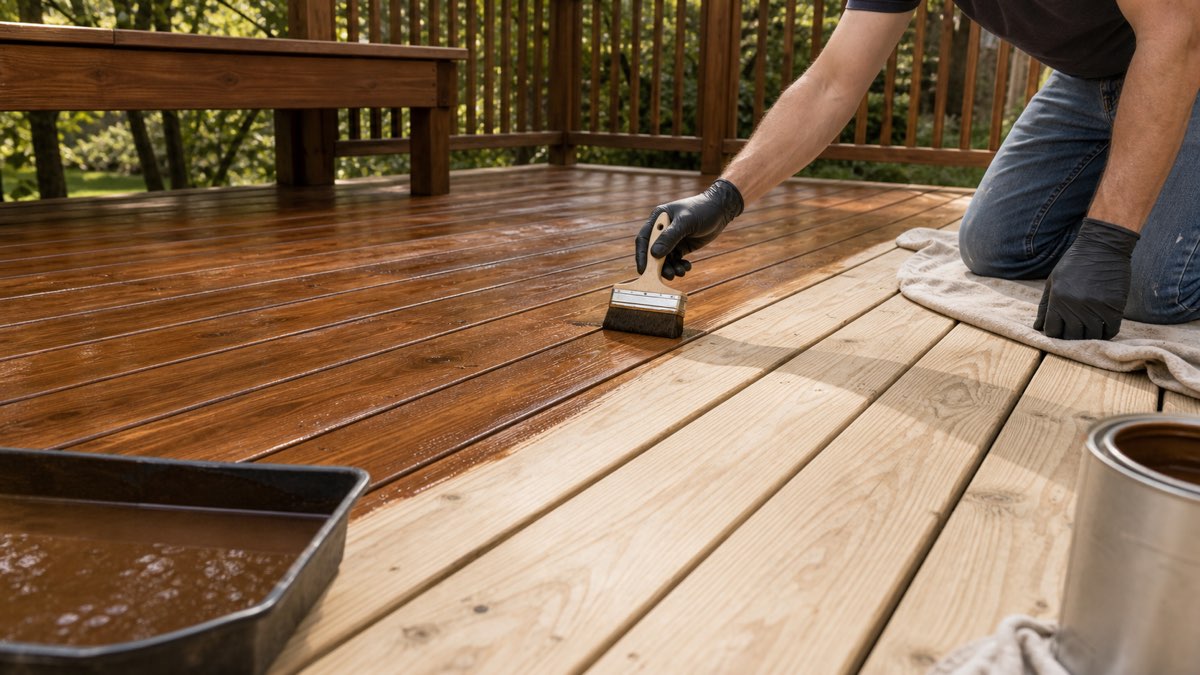
- Horizontal (floor, stair treads) — foot traffic abrades pigment off in 12–24 months without a second coat. One coat on a horizontal surface is a refresh, not a finish.
- Vertical (railings, balusters, fascia, risers) — no traffic, mostly weather. One coat is usually correct; a second coat on a vertical face drips and pools before it absorbs.
This calculator splits the two and lets you set coats per group. Floor defaults to 2 coats, railings to 1 — the configuration most spec sheets recommend in their fine print.
Coverage by stain type — read the can, then sanity-check
| Type | ft²/gal (label) | Pigment / look | Typical life |
|---|---|---|---|
| Clear sealer | 300–400 | None — water repellent only | 1 year |
| Transparent stain | 200–300 | Light tint, full grain visible | 1–2 years |
| Semi-transparent | 250–350 | Moderate pigment, grain visible | 2–4 years |
| Semi-solid | 200–275 | Heavy pigment, grain muted | 3–5 years |
| Solid stain | 200–300 | Opaque — paint-like | 4–7 years (then strips) |
This calculator uses the midpoint of each range. The wider the range, the more variation between brands — film-building products sit at the high end, deep-penetrating products at the low end.
Wood condition is the silent multiplier
Coverage on the label is for smooth, previously sealed wood. Real decks rarely qualify:
- Smooth (×1.00)
- Sanded boards, intact previous finish. The label numbers work as-is.
- Rough or rough-sawn (×1.15)
- Fresh-cut PT, rough side facing up, or post-tooth grinding. Roughly 15% more product to fill the grain.
- Weathered, dry, porous (×1.20)
- Decks more than two seasons old without finish. First coat soaks in fast — sometimes the wood drinks a full third of a gallon before it stops asking for more.
- New pressure-treated
- Special case — see below.
The new pressure-treated lumber problem
PT lumber leaves the mill saturated with preservative carrier (usually water). Until that moisture leaves the wood, stain cannot penetrate — it sits on the surface and peels after the first rain. Waiting period: 1–6 months depending on climate and board thickness.
Water-bead test. Sprinkle a few drops on the boards. If they bead up, the wood is still too wet — wait. If they are absorbed within 10 minutes, the wood is ready. Test in several spots; sun-exposed boards dry faster than shaded ones.
Worked example — 16×20 deck with 60 ft of railing
A typical second-floor deck: 320 ft² floor, 60 linear ft of railing 3 ft tall, semi-transparent stain on smooth wood.
- Floor area:
16 × 20 = 320 ft² - Floor gallons (2 coats):
320 × 2 × 1.00 / 300 = 2.13 gal - Railing area (linear ft × height × 1.5 wrap factor):
60 × 3 × 1.5 = 270 ft² - Railing gallons (1 coat):
270 × 1 × 1.00 / 300 = 0.90 gal - Total raw:
2.13 + 0.90 = 3.03 gal - Buy: 4 gallons (ceiling rounding absorbs the typical 5–10% waste)
The 1.5 wrap factor approximates standard 2×2 balusters at 4″ spacing plus a top and bottom rail. For ornate Victorian balustrades, multiply final gallons by 1.2; for cable rail with minimal vertical surface, multiply by 0.6.
The application weather window
Even the best product fails outside its temperature and humidity window:
- Temperature — 50–90 °F (10–32 °C). Below 50 °F the solvent does not flash off; above 90 °F it flashes too fast and leaves lap marks.
- Humidity below 80%, no rain forecast for 24 h after application.
- Sun — work in shade or late afternoon. Direct hot sun bakes the surface dry before the stain penetrates.
Frequently asked
Semi-transparent or solid?
Semi-transparent fades. Solid peels. If your deck still has visible grain and the previous finish is faded but intact, stay semi-transparent — re-coating is a wash-and-roll job. Once you go solid, the only way back is chemical stripping.
One coat or two on the floor?
Two — almost always. The exception is a refresh on a deck stained within the last 24 months that still looks even; one coat in that case acts as maintenance.
Stain the underside?
Most decks are stained top-only. The underside dries slowly and rarely sees UV — staining it can trap moisture against framing and accelerate rot. Skip it unless the underside is a covered living space.
Estimator only. Coverage on porous, weathered, or new pressure-treated wood can run 30–40% below the label number on the first coat. When in doubt, buy one extra quart from the same dye lot — running out mid-pour and starting a new batch leaves a visible tide line at the joint.
