Estimate pounds of grass seed and bag count by area, species, and new lawn vs overseed application — KBG, Tall Fescue, Bermuda, and seven more species.
| Bag size | Bags needed | Total lb |
|---|---|---|
| 5 lb | 1 | 5 |
| 10 lb | 1 | 10 |
| 25 lb | 1 | 25 |
| 50 lb | 1 | 50 |
Advanced · seed purity, germination, price per lb
Quality blends are 95%+ pure / 85%+ germination. Bargain blends are 85% / 75%. Adjusted seed lb = base lb ÷ (purity × germination).
Seeding rate reference by species
| Species | New lawn (lb/1000 sqft) | Overseed (lb/1000 sqft) | Season |
|---|---|---|---|
| Kentucky Bluegrass | 2–3 | 1–2 | Cool |
| Tall Fescue | 6–10 | 4–8 | Cool |
| Perennial Ryegrass | 5–8 | 3–5 | Cool |
| Fine Fescue | 4–5 | 2–3 | Cool |
| Bermuda (hulled) | 1–1.5 | 0.5–1 | Warm |
| Zoysia | 1–2 | 0.5–1 | Warm |
| Centipede | 0.25–0.5 | 0.1–0.25 | Warm |
| Bahia | 5–7 | 2–4 | Warm |
| St. Augustine | Not available as seed — sod or plugs only | Warm | |
Rates from Penn State Extension, University of Georgia Extension, and NTEP species data; verify against your seed tag for purity/germination.
Planting season — when to seed
Cool-season grasses
Optimal window is late summer to early fall: soil is still warm (50–65°F at 4″ depth), nights are cooling, weed pressure is lowest, and seedlings have two cooling-then-cold months to root before winter. September is the prime month in most of the US transition zone and north. Spring seeding (April–May) works but seedlings race summer heat and broadleaf weed competition.
Warm-season grasses
Optimal window is late spring to early summer: soil temp 65–75°F sustained. Bermuda, Zoysia, Centipede, and Bahia all want consistent warm soil for germination. Seeding before May in the Deep South or before June in the upper South gives uneven stands. Fall seeding of warm-season grasses fails — seedlings die at first frost.
Soil temperature anchor
Air temperature lags soil temperature by 1–2 weeks. Use a soil thermometer at 4″ depth, or check the closest agricultural-extension network station — measurements are free and more reliable than calendar dates.
FAQ
Can I overseed a warm-season lawn?
Yes, but the goal is different from cool-season overseeding. Warm-season lawns go dormant (brown) in fall, so people overseed perennial ryegrass on top of Bermuda or Zoysia for winter color. Use 6–10 lb of perennial ryegrass per 1000 sqft for green winter coverage; the ryegrass dies out in summer heat. Do not "overseed" Bermuda with more Bermuda in the same season — established Bermuda crowds new seedlings out.
Is more seed better?
No. Over-seeded turf goes through a stand-thinning cycle — too many seedlings compete for the same root zone, the weak ones die, and the surviving plants are stressed. Stick to the recommended range. Doubling the rate wastes seed and creates a weaker lawn, not a thicker one.
Why is St. Augustine missing from seed calculators?
St. Augustine grass produces almost no viable seed under cultivation, and what little is produced does not breed true. The commercial cultivars (Floratam, Palmetto, CitraBlue, Bitter Blue) are vegetatively propagated and sold exclusively as sod squares or plugs. Calculate sod by square footage and pallet coverage instead of lb of seed.
Should I cover seed with straw or topsoil?
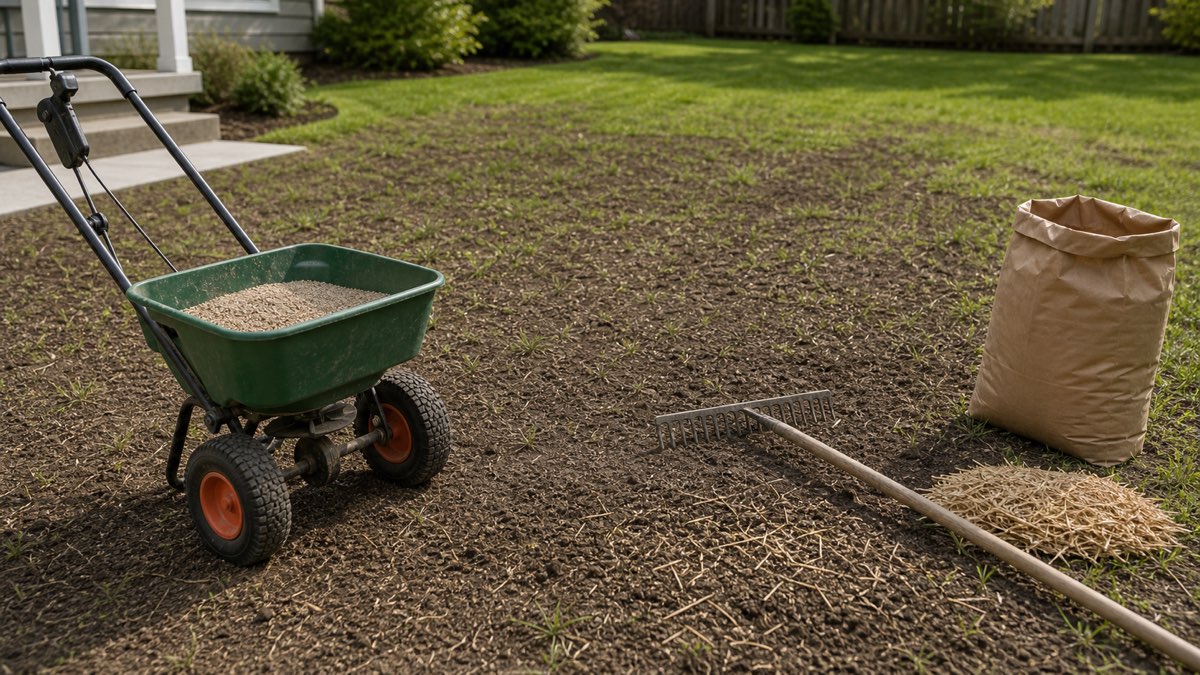
Topsoil better — a 1/8″ to 1/4″ scratch of fine soil or compost over the seed bed protects from birds and keeps moisture in. Straw works but introduces weed seeds and matts down in rain. Skip both on slopes and use erosion-control blanket instead.
Describe the task to the AI assistant and continue from the result.
Open AI assistant →Rate guidance by species
Seeding rate follows seed size and growth habit. Kentucky Bluegrass is tiny (≈2 million seeds per pound) and tillers from the crown — 2.5 lb covers 1000 sqft. Tall Fescue seed is three times larger and is a bunch grass without much spread, so the same coverage needs 8 lb. Bermuda hulled seed germinates in 5–10 days at 1 lb per 1000 sqft because of stolon growth; unhulled Bermuda doubles the rate as the seed coat halves germination.
| Species | New lb/1000 | Overseed lb/1000 | Season |
|---|---|---|---|
| Kentucky Bluegrass | 2–3 | 1–2 | Cool |
| Tall Fescue | 6–10 | 4–8 | Cool |
| Perennial Ryegrass | 5–8 | 3–5 | Cool |
| Fine Fescue | 4–5 | 2–3 | Cool |
| Bermuda (hulled) | 1–1.5 | 0.5–1 | Warm |
| Zoysia | 1–2 | 0.5–1 | Warm |
| Centipede | 0.25–0.5 | 0.1–0.25 | Warm |
| Bahia | 5–7 | 2–4 | Warm |
Worked example — half-acre new tall fescue lawn
- Area:
0.5 × 43,560 = 21,780 sqft - Rate (TF new): 8 lb / 1000 sqft
- Seed:
21,780 / 1000 × 8 = 174.24 lb - Bag combo:
3 × 50 lb + 1 × 25 lb = 175 lb(0.76 lb leftover) - At 95% purity / 85% germination:
174.24 / 0.808 = 215.7 lb PLS— 4 × 50 + 1 × 25 = 225 lb
Seasonal timing — soil temperature, not the calendar
Cool-season grasses (KBG, Tall Fescue, Ryegrass, Fine Fescue) germinate fastest when soil at 4″ depth holds 50–65°F — late August through mid-October in the US transition zone, with two months of root-down before winter. Spring seeding (April–May) is the second-best window but seedlings race summer heat and crabgrass.
Warm-season grasses (Bermuda, Zoysia, Centipede, Bahia) want soil sustained above 65°F — late May through July. Fall warm-season seeding fails: seedlings die at first frost regardless of how well established. A $5 soil thermometer measured at 4″ depth is more reliable than a calendar.
Overseeding tactics
Overseeding uses roughly half the new-lawn rate — filling thin patches, not building from scratch. Mow short (1.5–2″), verticut or core-aerate so seed reaches dirt instead of thatch, apply 4–6 lb / 1000 sqft of tall fescue, rake lightly, water 14 days. For winter color on dormant warm-season lawns, overseed perennial ryegrass at 6–10 lb / 1000 sqft on Bermuda or Zoysia — the rye stays green through frost, dies out as warm-season grass wakes in summer.
Common questions
Can I overseed a warm-season lawn?
Overseed warm-season turf with a different species (ryegrass for winter green-up), not with more of the same. Established Bermuda is too competitive — new Bermuda seedlings get crowded out by existing runners. For thin spots in a Bermuda lawn, plug or sprig rather than seed.
Is more seed better?
No. Doubling the rate gives a denser first month but creates a weaker mature lawn — seedlings compete for the same root zone, weak ones die, survivors are stressed. Stick to the species rate; spend the saved money on a soil thermometer and starter fertilizer.
Why is St. Augustine missing from grass seed calculators?
St. Augustine produces almost no viable seed under cultivation, and the named cultivars (Floratam, Palmetto, CitraBlue, Bitter Blue) do not breed true from what little they make. Every commercial St. Augustine lawn in the US starts from sod squares or plugs — calculate by square footage, not lb of seed.
What is the bare-patch minimum?
A 200 sqft tall fescue repair needs only 1.6 lb of seed by the math, but no retailer sells less than a 5 lb bag. The calculator’s bare-patch mode rounds up to a single 5 lb minimum buy; use leftovers within 12 months before germination drops below 60%.
Estimator only. The bag tag at the retailer overrides the calculator — actual seed weight, pure live seed (PLS), purity, and germination are the four numbers that decide what you really need. Verify rates with local agricultural extension before large or commercial work.
