Estimate mulch in cubic yards and 2 or 3 cu ft bags by shape, depth, and area — rectangle, circle, L-shape, tree-ring donut, or custom area.
Inches accept fractions: 12 5/8, 12-5/8, or 12.625
| Bag size | Coverage @ depth | Bags needed |
|---|---|---|
| 2 cu ft | 8.0 sqft | 7 |
| 3 cu ft | 12.0 sqft | 5 |
Advanced · prices · custom depth & bag size
Depth reference · coverage per yard
| Depth | When to use | sqft per yd³ |
|---|---|---|
| 1″ | Refresh existing mulch layer | 324 |
| 2″ | Vegetable beds, fine-textured mulch | 162 |
| 3″ | Standard ornamental beds | 108 |
| 4″ | Weed suppression, hot/dry climates | 81 |
| 6″ | Playgrounds, fall-protection surface | 54 |
Coverage = 27 ft³ per yd³ ÷ depth in feet. A 2 cu ft bag covers ≈8 sqft at 3″, ≈4 sqft at 6″, ≈12 sqft at 2″.
Mulch types & how often to refresh
By material
| Type | Weight / yd³ | Lifespan | Use for |
|---|---|---|---|
| Hardwood chip | ~800 lb | 1–2 years | Ornamental beds, slopes |
| Bark / nuggets | ~500 lb | 2–3 years | Decorative, around shrubs |
| Pine straw | ~300 lb | 1 year | Acid-loving plants, southern beds |
| Dyed wood | ~850 lb | 1–2 years | Colour-stable beds along walks |
| Rubber | ~1200 lb | 10+ years | Playgrounds (no plant beds) |
When to refresh
Most organic mulches lose half their depth in one season as the bottom layer composts. Top up to 3″ at the start of growing season; do not stack a fresh 3″ on top of last year's full layer or you will smother roots.
FAQ
How do I keep mulch from washing off a slope?
Heavier, shreddy materials (double-shredded hardwood) interlock and stay put. Bark nuggets and pine straw float and wash. On slopes over 1:4, install jute netting first or use shredded hardwood at 3–4″ — the rougher fibres bind together.
Is rubber mulch worth it?
For playgrounds, yes — it meets ASTM fall-attenuation standards and lasts a decade. For plant beds, no — it does not feed the soil, holds heat, and is hard to remove. Use it where impact-protection matters, not where things grow.
Can I lay mulch on top of weed fabric?
You can, but it limits the soil benefit — organic mulch breaks down into the topsoil, and fabric blocks that. Use cardboard underlayment for an annual reset instead: it composts in a season and lets worms move freely.
Describe the task to the AI assistant and continue from the result.
Open AI assistant →How deep should mulch be?
Depth decides whether mulch helps or smothers. Too thin and weeds punch through; too thick and roots suffocate.
| Depth | When to use | sqft per yd³ |
|---|---|---|
| 1″ | Refresh — last year’s mulch half-present | 324 |
| 2″ | Vegetable beds, fine-textured products | 162 |
| 3″ | Standard ornamental beds — default | 108 |
| 4″ | Aggressive weed suppression, hot climates | 81 |
| 6″ | Playgrounds, fall-impact zones | 54 |
A 2 cu ft bag covers ≈8 sqft at 3″, ≈12 sqft at 2″, ≈4 sqft at 6″.
Worked example — 200 sqft at 3″
- Depth in feet:
3 / 12 = 0.25 ft - Volume:
200 × 0.25 = 50 ft³ - Cubic yards:
50 / 27 = 1.85 yd³ - 2 cu ft bags:
ceil(50 / 2) = 25 bags - 3 cu ft bags:
ceil(50 / 3) = 17 bags - 1.85 yd³ is the “compare” zone — a pallet of 40 × 2 cu ft is ≈3 yd³, so bulk delivery is on the edge of paying off.
Donut, not volcano — the tree-ring rule
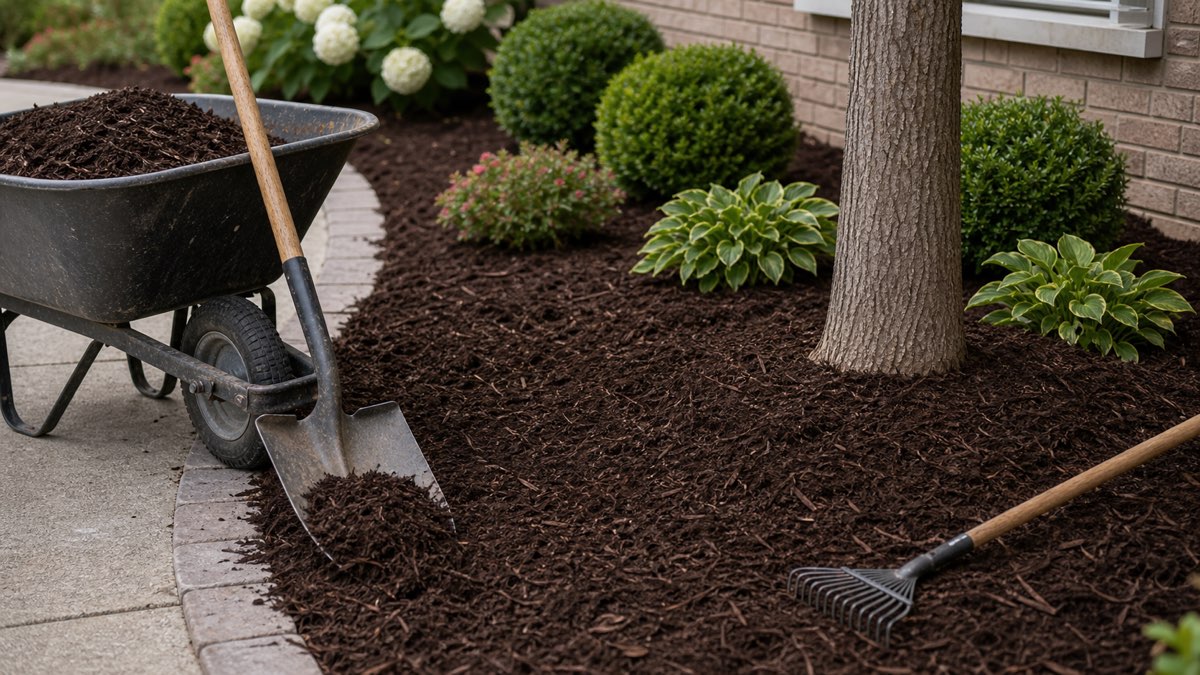
Piling mulch against the trunk is the most common gardening mistake — and it kills trees. Bark needs air; constant moisture against the cambium invites fungal disease, and rodents that nest in piled mulch chew the bark off in winter. Keep a 3–6″ trunk-clearance ring bare and shape the mulch into a flat donut. The calculator’s tree-ring shape uses the donut formula π × (outer_radius² − inner_radius²) automatically.
Mulch by material
- Hardwood chip (≈800 lb/yd³, 1–2 years)
- Standard for ornamental beds. Double-shredded interlocks on slopes.
- Bark / nuggets (≈500 lb/yd³, 2–3 years)
- Decorative, slower to break down. Floats in heavy rain — bad for slopes.
- Pine straw (≈300 lb/yd³, ~1 year)
- Acidic, classic in the southern US. Good around azaleas and blueberries.
- Dyed wood (≈850 lb/yd³, 1–2 years)
- Colour-stable for HOA-style beds. Dye is iron oxide or carbon — safe for plants.
- Rubber (≈1200 lb/yd³, 10+ years)
- Only for playgrounds — meets ASTM F1292 fall-attenuation. Do not use in plant beds.
Bags or bulk?
Break-even sits around 3 yd³. Under 1 yd³, a few bags from a big-box store beat any minimum-delivery charge. Between 1 and 3 yd³, bags and bulk land within a few dollars — pick by labour preference. Above 3 yd³, bulk delivery wins on $/yd³ and on your back: a 7 yd³ playground order is 100 trips from the pallet in bags.
Common questions
How often should I refresh mulch?
Most organic mulches lose half their depth in a season as the bottom composts into topsoil. Top up to 3″ in spring — but do not stack a full 3″ on top of last year’s full layer, you will smother roots. If the existing layer is still 2–3″, a 1″ refresh is enough. Rake first to break up any matted crust.
Does mulch type change the volume I need?
Volume is volume — 1 yd³ of pine straw and 1 yd³ of rubber cover the same square footage at the same depth. The difference is weight: rubber is four times heavier per cubic yard, which matters for trailer loads.
Can I lay mulch on top of weed fabric?
You can, but you lose the main benefit: organic mulch breaks down into the topsoil, and fabric blocks that exchange. For an annual reset, plain cardboard under fresh mulch composts away in one season. Use fabric only under inorganic mulch — gravel, decorative stone — where you never plan to plant.
Estimator only. Bagged mulch is sold by cubic feet on the label; bulk yards are loose volume that settles 10–20% in the bed. Add settling above if you want compaction baked in. For other landscape jobs see the gravel calculator or topsoil calculator.
