Convert between roof pitch X/12, degrees, percent slope, and roof-area multiplier with material suitability hints.
Inches accept fractions: 12 5/8, 12-5/8, or 12.625
Pitch reference table
| Pitch | Angle | Percent | Multiplier | Use |
|---|---|---|---|---|
| 0.25/12 | 1.19° | 2.1% | 1.000 | Membrane / low-slope only |
| 2/12 | 9.46° | 16.7% | 1.014 | Low-slope, special underlayment |
| 4/12 | 18.43° | 33.3% | 1.054 | Threshold for many asphalt shingles |
| 6/12 | 26.57° | 50.0% | 1.118 | Common residential |
| 8/12 | 33.69° | 66.7% | 1.202 | Steep residential |
| 10/12 | 39.81° | 83.3% | 1.302 | Steep, walkability limit |
| 12/12 | 45.00° | 100% | 1.414 | Very steep — fall protection mandatory |
| 18/12 | 56.31° | 150% | 1.803 | Mansard / architectural feature |
What pitch actually means
Roof pitch is a ratio between vertical rise and horizontal run. US framers write it as rise / 12 — a 6/12 roof rises 6 inches for every 12 inches of horizontal travel. Architects use degrees. Drainage engineers use percent. The fourth output — the roof-area multiplier √(1 + (rise/run)²) — converts building footprint to slanted roof surface, which is the number you actually need to size shingles, underlayment, or metal panels. A 24×40 ft house at 6/12 pitch has 960 ft² of footprint but 1,073 ft² of roof to cover (960 × 1.118).
How to measure pitch on an existing roof
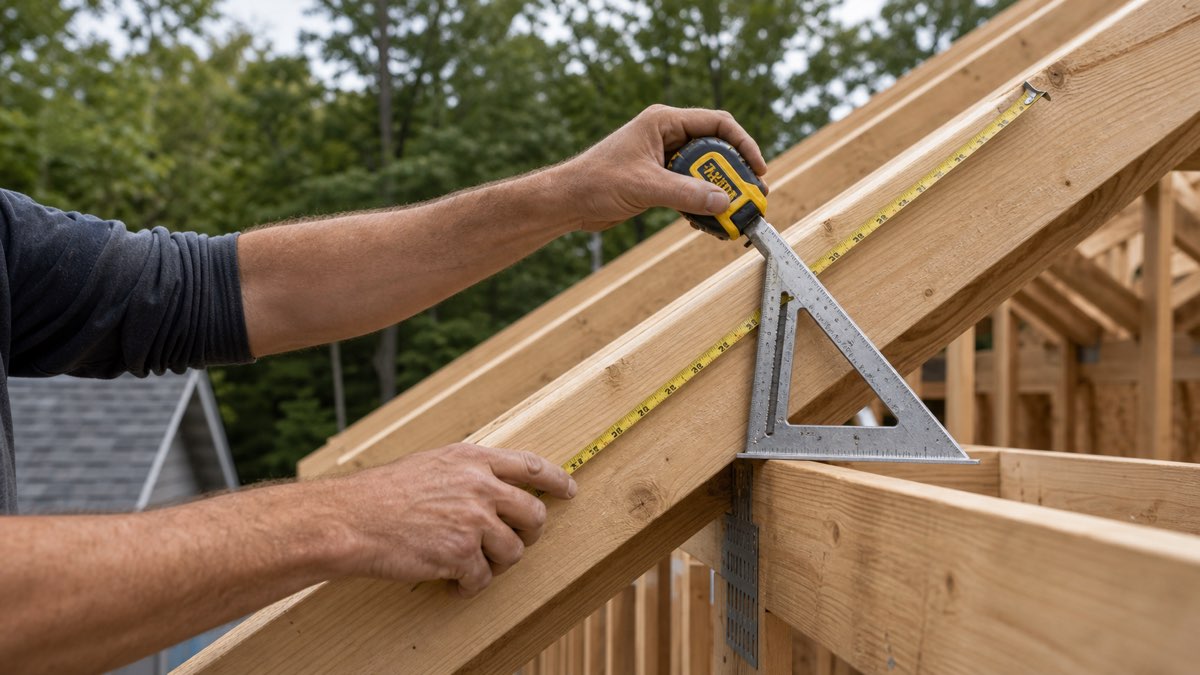
- Level method. Hold a 24-inch level against the underside of a rafter. Place a tape measure at the 12-inch mark on the level, perpendicular to it. The inches from the tape to the rafter is the rise. A reading of 6″ = 6/12.
- Phone inclinometer. Lay a smartphone flat on the roof or rafter — any free spirit-level app reads degrees directly. Convert here: 18.4° = 4/12, 26.6° = 6/12, 33.7° = 8/12.
Worked example — 6/12 roof on a 24×40 ft footprint
- Pitch ratio:
6/12 = 0.5 - Angle:
atan(0.5) × 180/π = 26.57° - Percent slope:
0.5 × 100 = 50% - Multiplier:
√(1 + 0.5²) = √1.25 = 1.1180 - Footprint:
24 × 40 = 960 ft² - Roof surface (two-sided gable):
960 × 1.118 = 1,073 ft² - With 10% shingle waste:
≈ 1,180 ft²— about 35 bundles of three-tab or 40 bundles of architectural.
This footprint-to-roof conversion underpins both the roofing material calculator and the gutter sizing — gutters drain effective horizontal projection, not slanted area.
Material suitability by pitch
Manufacturer datasheets set the actual minimum — the ranges below are common defaults, always cross-reference the bundle wrapper and your local code.
- Below 2/12 (under 9.5°)
- Low-slope only: built-up roof, modified bitumen, single-ply membrane (EPDM, TPO, PVC). Standard asphalt shingles are not rated below 2/12.
- 2/12 to 4/12 (9.5°–18.4°)
- Asphalt shingles permitted with special underlayment (double saturated felt or full self-adhering ice-and-water shield). Standing-seam metal qualifies down to 1/12 in many product lines. Concrete and clay tile usually not rated here.
- 4/12 to 9/12 (18.4°–36.9°)
- Standard residential range. Asphalt architectural and three-tab, metal panel, concrete and clay tile, slate — all qualify.
- 10/12 to 12/12 (39.8°–45°)
- Steep range. All common materials still work, but labour rises sharply and toe boards become essential. Many shingle manufacturers require six nails instead of four at these pitches.
- Above 12/12 (over 45°)
- Mansard, gambrel sides, or architectural feature pitches. Mechanical attachment required for shingles to prevent hot-weather slip.
Common questions
Why does my framer say “8/12” while my architect says “33.69°”?
Different trades, same roof. Carpenters use rise-over-12 because framing squares are graduated in inches and the math is mental. Architects and engineers use degrees because every other angle on the drawing is in degrees. Both are exact: 8/12 is precisely 33.6901°.
Is steeper better for snow shedding?
Mostly yes — a 12/12 sheds faster and accumulates less drift than a 4/12. But steeper also means more wind uplift and more material per square foot of footprint (the multiplier penalty). The sweet spot in most snow regions is 6/12 to 9/12 — aggressive enough to shed, not so steep that labour and material costs double.
Can I have different pitches on the same roof?
Routinely. An 8/12 main gable with a 3/12 porch is a classic American profile. Calculate each plane separately, multiply each by its own multiplier, sum the results. Hip roofs use the same multiplier as gables of the same pitch — area is footprint × multiplier, just split across four planes instead of two.
Estimator only. Manufacturer minimum-slope rules on the bundle wrapper, your local International Residential Code adoption, and the IBC for commercial work all override generic guidance. Pull the product datasheet before pulling the trigger on a 2/12 shingle install.
