Estimate concrete volume in cubic yards, 40/60/80 lb bag counts, and ready-mix truckloads for slabs, patios, driveways, and pads.
12 5/8, 12-5/8, or 12.625.| Bag size | Yield ft³ | Bags (with waste) |
|---|---|---|
| 40 lb | 0.30 | 123 |
| 60 lb | 0.45 | 82 |
| 80 lb | 0.60 | 62 |
Advanced options · prices · custom thickness
Reverse: I have a fixed number of bags
Enter how many bags you have and your target thickness — see the square footage you can pour.
Describe the task to the AI assistant and continue from the result.
Open AI assistant →How the math works
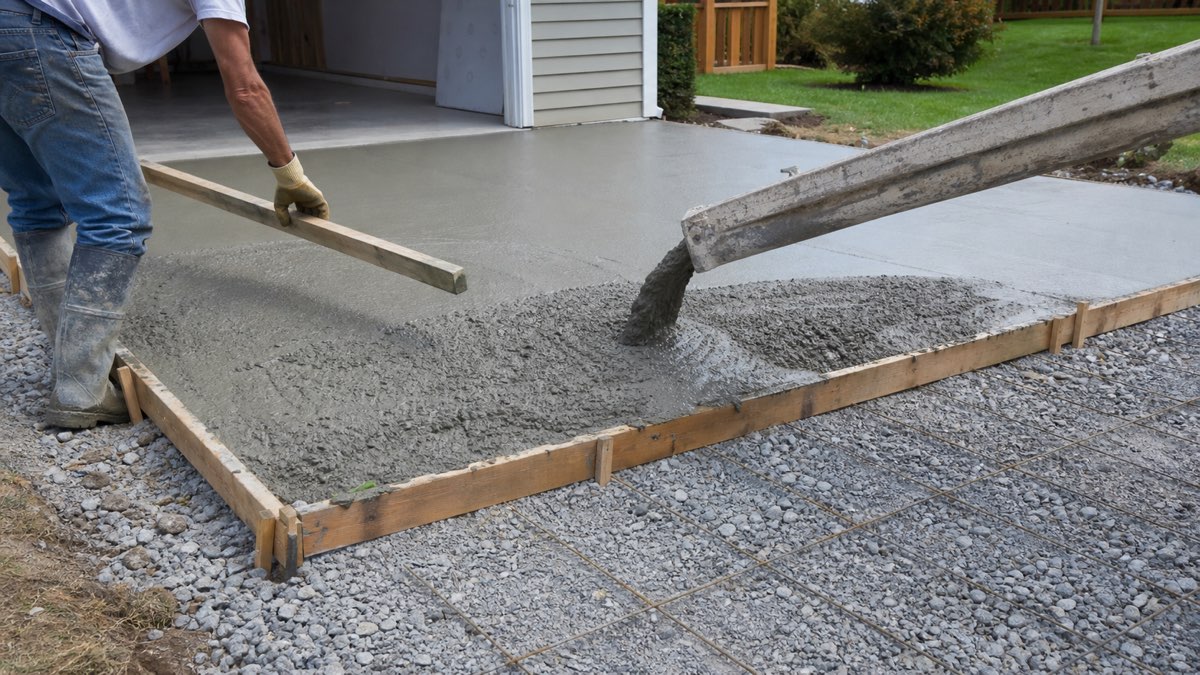
Pouring a slab is volume work. The formula is the same whether you bag-mix on a wheelbarrow or call for a ready-mix truck:
- Convert thickness inches to feet:
thickness_ft = thickness_in / 12 - Multiply the three dimensions:
base_ft³ = length × width × thickness_ft × quantity - Convert to cubic yards (how concrete is ordered):
base_yd³ = base_ft³ / 27 - Add a waste margin — 10% is the residential default:
recommended_yd³ = base_yd³ × (1 + waste%) - If you are bagging it, round up on every size:
bags = ceil(recommended_ft³ / bag_yield)
The exact ratio is 1 yd³ = 27 ft³ — the cubic yards to cubic feet converter handles inverse checks if you are reconciling a supplier slip.
Worked example — a 20×40 ft driveway at 6″
The borderline case where bags stop making sense and ready-mix wins on labour:
- Thickness in feet:
6 / 12 = 0.5 ft - Base volume in cubic feet:
20 × 40 × 0.5 × 1 = 400 ft³ - Base volume in cubic yards:
400 / 27 = 14.81 yd³ - With a 10% waste margin:
14.81 × 1.10 = 16.30 yd³ - At a 10 yd³ truck capacity:
ceil(16.30 / 10) = 2 truckloads
Bagging the same pour with 80-lb bags (0.60 ft³ each) would mean ceil(440 / 0.60) = 734 bags — about 17 pallets. Bag math is the wrong tool for a driveway.
Coverage reference — square feet per cubic yard
| Thickness | ft² per 1 yd³ | m² per 1 m³ |
|---|---|---|
| 4″ (10 cm) — patio, walkway | 81 ft² | 10 m² |
| 5″ (13 cm) — residential driveway | 65 ft² | 7.7 m² |
| 6″ (15 cm) — heavy driveway, shed pad | 54 ft² | 6.7 m² |
| 8″ (20 cm) — commercial, pole base | 40 ft² | 5 m² |
Bag yields
- 40-lb bag
- 0.30 ft³ — ≈90 bags per cubic yard, cheapest per bag but heaviest workload per cubic foot.
- 60-lb bag
- 0.45 ft³ — ≈60 bags per cubic yard, the middle ground.
- 80-lb bag
- 0.60 ft³ — ≈45 bags per cubic yard, fewer trips from the pallet but heavier per carry.
Yields are manufacturer-quoted (Quikrete, Sakrete, Sika). Real output sits 0–3% lower due to subgrade absorption and bag residue.
Common questions
How much waste should I add?
10% is the residential default — it matches what Sakrete prints on the bag. Bump to 15% for irregular formwork, loose subgrade, or pours against existing slab. Interior repairs in controlled forms: 5% is fine.
Bags or ready-mix?
Under 1 yd³, bags usually beat the short-load truck fee. Between 1 and 5 yd³, compare bag price plus your labour against the supplier’s minimum delivery charge — most bill any unused truck capacity. Above 5 yd³, ready-mix wins on consistency and crew time. If your slab is mostly area-by-depth and you already know the yards, the cubic yards to square feet coverage tool answers the inverse “how thick can I pour these yards?” question.
Does temperature change the order?
Volume does not change with temperature, but workability does. Cold pours need an accelerator (1–2% of mix volume); hot pours need a retarder and pre-wet forms. Order the same yards, plan more crew.
Estimator only. Use this widget to size the trip to the supplier, not as engineering acceptance — structural slabs and load-bearing pads need a structural engineer’s stamp and a proper mix design. For shopping-list conversions, the volume unit converter handles 24 units in one place.
