Estimate concrete volume and bag count for round piers, sonotubes, square pads, rectangular spread footings, and Bigfoot-style bell bases. Includes frost-depth check and per-footing breakdown.
12 5/8, 12-5/8, or 12.625.| Bag size | Yield ft³ | Bags (with waste) |
|---|---|---|
| 40 lb | 0.30 | 91 |
| 60 lb | 0.45 | 61 |
| 80 lb | 0.60 | 46 |
Reinforcement & code reference
Standard residential dowel + lap (IBC, ACI 318):
- One
#4vertical bar (½″) cast into pier, 3″ clear from concrete face. - Lap above pier (Class B tension): 40 × bar diameter = 20″ for #4 grade-60.
- Compression-only lap: 12 × bar diameter = 6″.
- Spread footing under wall: minimum two #4 bars longitudinal, 3″ cover from earth.
- Bigfoot-style bell base: lap dowel into shaft, no bell rebar required for residential deck loads ≤ 60 psf.
Always defer to permit drawings and local code. This calculator does not size rebar for engineered footings.
Advanced — prices, custom waste
Describe the task to the AI assistant and continue from the result.
Open AI assistant →How the math works
Footings are volume work. Whether you pour into a sonotube, a square form, a continuous strip, or a Bigfoot-style bell, the order is one of three formulas:
- Round shaft / sonotube:
V = π × (d/2)² × h— diameter and depth in feet. - Square or rectangular pad:
V = side_a × side_b × depth. - Bell base (Bigfoot BF20/BF24/BF28): shaft cylinder plus the wider bell on top — sum of two cylinders. The widget treats the bell as a short flat cylinder; this is slightly conservative compared with the true frustum and the difference is absorbed by the 10% waste margin.
Multiply by the number of identical footings, add waste, and divide by bag yield to get bag count. For slabs and patios use the slab concrete calculator instead — it shares the same yard-and-bag math but optimises for area pours.
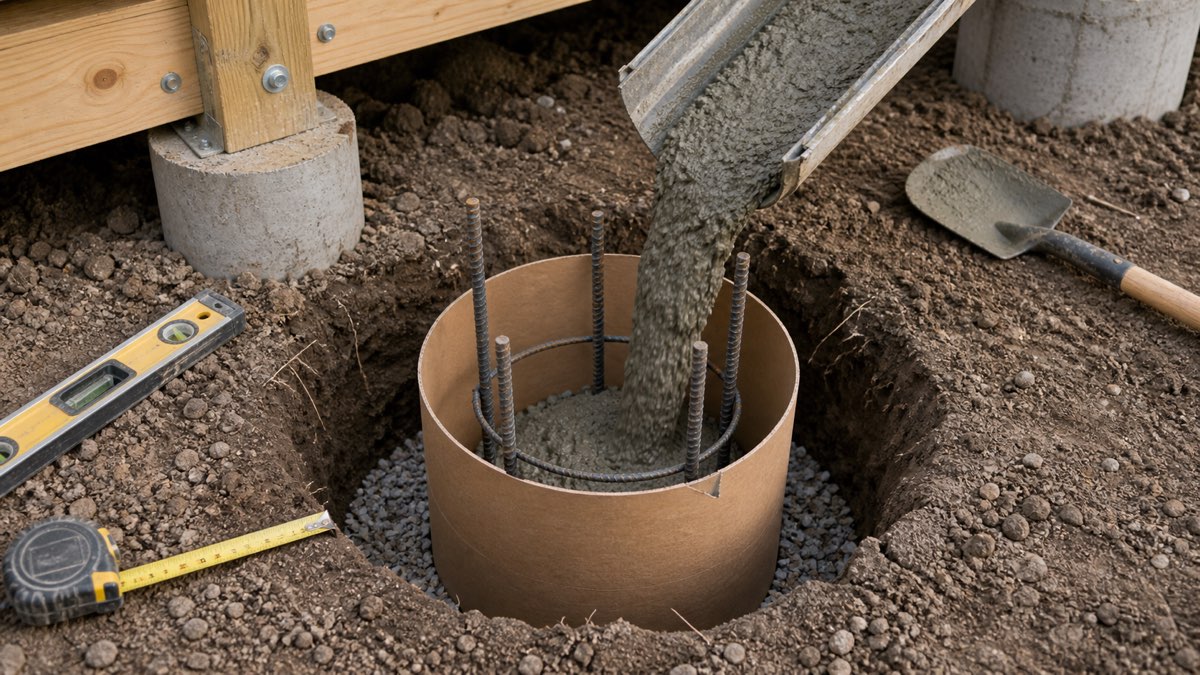
Worked example — 9 deck piers, 12″ × 42″ sonotubes
The most common deck rebuild scenario:
- Per-footing volume:
π × (12/24)² × (42/12) = π × 0.25 × 3.5 = 2.749 ft³ - Total base for nine piers:
9 × 2.749 = 24.74 ft³ - With a 10% waste margin:
24.74 × 1.10 = 27.21 ft³ - In 80-lb bags (yield 0.60 ft³):
ceil(27.21 / 0.60) = 46 bags - Sonotube shopping:
9 × 3.5 ft = 31.5 linear feet of 12″ tube— typically sold in 4-ft and 12-ft sticks, so three 12-ft sticks gives a couple feet of trim.
Inverting that math the other direction — how many cubic yards a stack of bags will pour — is faster on the cubic-yards-to-coverage tool.
Frost-depth reference (US, IRC R403.1.4 zones)
| Zone | Minimum frost depth | Typical states |
|---|---|---|
| Coastal South | 0″ | FL, gulf coast TX/LA, southern AZ |
| Mild South | 12″ | GA, AL, MS, SC, low-elevation TN |
| Mid-Atlantic / Lower Plains | 24″ | VA, NC, KY, MD, OK, AR |
| Midwest median | 36″ | OH, IN, IL, MO, southern PA, NY downstate |
| Northern | 48″ | MN, WI, MI UP, ND, NH, VT |
| Far North / Canada | 60″+ | ME, MT, AK lower 48 border, prairie provinces |
These are minimums under the IRC; many local codes are deeper. The footing bottom must rest on undisturbed soil at or below the local frost line — when it does not, frost heave lifts the pier, racks the deck, and cracks the slab it supports.
Bag yield reference
- 40-lb bag
- 0.30 ft³ — about 90 bags per cubic yard. Cheapest per bag, the most trips from the pallet.
- 60-lb bag
- 0.45 ft³ — about 60 bags per cubic yard. The middle-ground choice for small pier jobs.
- 80-lb bag
- 0.60 ft³ — about 45 bags per cubic yard. Fewest carries, heaviest each.
Yields are manufacturer-quoted (Quikrete, Sakrete, Sika). Real-world output sits roughly 0–3% lower because of subgrade absorption and bag residue — that is exactly what the waste margin covers.
Common questions
How deep should the footing go?
Two rules stack: the bottom must reach undisturbed soil and reach below the local frost line. In a 36″ frost zone, a 36″ shaft is the bare minimum if it lands on undisturbed bearing; in practice most decks use 42″ or 48″ to give 6″ of margin. South of the frost line, code typically still asks for 12″ minimum embedment so the pier does not pull out under uplift.
Round (sonotube) or square footing?
For deck piers and pergola posts, round wins on cost and waste — the form is disposable cardboard, the volume is small, and a 12″ Bigfoot bracket sits cleanly on top. Square pads make sense under continuous strip walls and under columns where the load spreads on a wider footprint than the shaft. If you need a continuous strip footing under a foundation wall, compute the section in the rectangular spread mode and multiply mentally for total length.
Do I need rebar in a deck pier?
Most jurisdictions require at least one #4 vertical dowel (½″ bar) cast into the pier with a 40-bar-diameter lap above for tension splices — that is 20″ of exposed lap for #4 grade-60. The dowel keeps the post-base anchor in plane under uplift and lateral loads. Bell bases under residential deck loads typically do not need bell rebar, but a permit drawing for any porch with a roof load almost always will. Always check the permit set before pouring; this widget sizes concrete only.
Estimator only. Use this widget to size the trip to the supplier, not as engineering acceptance — load-bearing footings under ledger boards, posts with roof loads, or anything supporting habitable space need a permit drawing and an engineer or licensed contractor. Local code wins on every frost depth, bearing pressure, and reinforcement detail.
