Estimate fence posts, rails, pickets or panels, concrete bags for footings, and gate hardware for wood privacy, picket, vinyl, and chain link fences.
| Item | Qty | Notes |
|---|---|---|
| Posts | 14 | 4×4 line · 6×6 gate posts |
| Rails | 36 | 3 per section · 8 ft sections |
| Pickets / boards | 205 | 5.5″ wide · 0.125″ gap · pickets (1×6 cedar/PT) |
| Concrete bags (60-lb) | 56 | 10″ dia × 36″ deep · 1.64 ft³/post |
| Concrete bags (80-lb) | 42 | alt size |
| Deck screws (3″) | 1,230 | 2 screws per picket × 3 rails |
| Gate hardware kits | 1 | hinges + latch per gate |
Advanced · footing depth, picket width, gap, post size
Inches accept fractions: 12 5/8, 12-5/8, or 12.625
How the math works
For a straight run:
- Subtract gate openings:
fence_run = length − gates × gate_width - Sections:
sections = ceil(fence_run / spacing) - Line posts (between ends):
sections − 1 - End posts: 2 for straight, 0 for closed perimeter
- Gate posts:
gate_count × 2 - Rails:
sections × rails_by_height(2 rails ≤4 ft; 3 rails 5–6 ft; 4 rails ≥7 ft) - Pickets:
fence_run_in / (picket_width + gap) - Footing concrete per post:
π × (dia / 24)² × depth_in / 12ft³ - Bags per post:
ceil(footing_ft³ / bag_yield); sums × post count
For closed perimeter we sum line+end of each side, then subtract shared corners so they are not double-counted; corners are output as their own bucket.
FAQ — spacing, footings, gates
How far apart should fence posts be?
8 ft is the standard center-to-center for wood and vinyl — it matches stock rail length and panel width. Chain link runs at 10 ft because the fabric is supported by tension wire between terminal posts. Going below 6 ft adds posts (cost) without strength benefit; going above 8 ft on wood causes rail sag in 5–7 years.
How deep do fence-post footings need to be?
Below the frost line. In the southern US that means 24″, most of the US is 30–36″, and northern tier states (MN, ND, ME, upper WI) require 42″ or deeper. If the footing sits above frost, the post heaves up every winter and racks the rails.
Do gate posts need to be larger than line posts?
Yes for any gate wider than 3.5 ft or taller than 5 ft. A 4×4 will rack under the hinge load. Use 6×6 wood or 2-7/8″ schedule-40 steel for the hinge-side gate post, with a 12″-diameter footing one step deeper than line posts.
How many rails does a 6-ft fence need?
Three: top, bottom (about 6″ off grade), and middle. A 4-ft fence uses two rails; a 7-ft or 8-ft fence uses four to keep pickets flat. This calculator picks the count automatically from the height field.
How post spacing changes the order
Spacing drives every other number. 8 ft to 10 ft saves ~20% on posts and concrete; 8 ft to 6 ft adds an extra post every 24 ft of run. Wood, vinyl and composite default to 8 ft because stock rail length is 8 ft and pre-assembled panels come in 6 or 8 ft widths. Wider on wood causes bottom-rail sag in 5–7 years. Chain link is the exception — 10 ft is standard because the fabric is held in tension between terminals (ASTM F567 allows up to 12 ft).
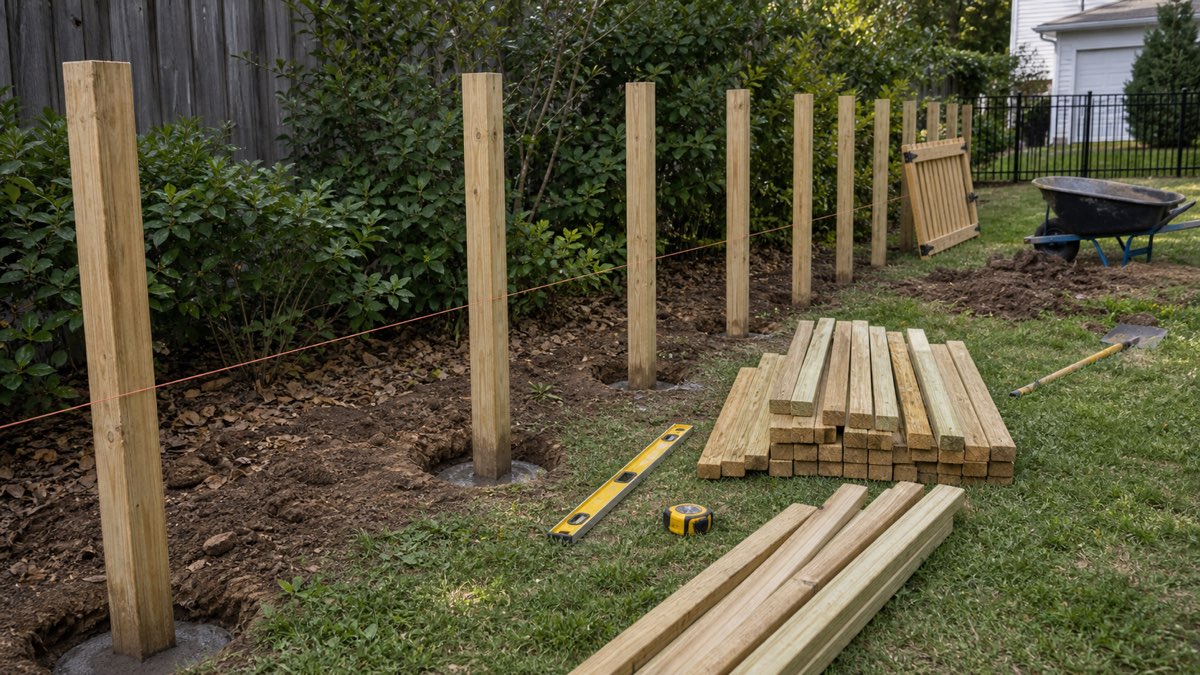
Footing depth by frost line
The single rule that decides whether your fence still stands in five winters: the bottom of the footing must sit below the local frost depth. If it does not, the soil below the post freezes, expands, and shoves the post upward every winter. After three or four cycles the rails are racked, the gate will not latch, and the pickets are diagonal.
| Region | Frost depth | Footing depth |
|---|---|---|
| Southern US (FL, TX, southern CA) | 0–6″ | 24″ minimum |
| Mid-Atlantic, Midwest, Pacific NW | 20–36″ | 36″ standard |
| Upper Midwest, New England, Inland NW | 40–48″ | 42″ or deeper |
| Northern tier (MN, ND, ME, AK) | 50–80″+ | 48″+ with bell bottom |
If you are inside city limits, the permit office publishes the local minimum — it is rarely shallower than 30″ and overrides any rule of thumb. The Advanced panel exposes the footing depth so you can match local code exactly.
Gate posts are not line posts
A 4×4 wood post takes a gate badly. The hinge side carries the gate weight as a lever — a 4-ft gate of 1×6 boards is ~60–80 lb at the latch corner, ~250 lb-ft of bending moment at the hinge post. A 4×4 cedar will sway in one season and rack rails by year two. Use a 6×6 wood post or 2-7/8″ schedule-40 steel on the hinge side, dig 42–48″ instead of 36″, and bell the bottom. The latch-side post can stay 4×4.
Worked example — 100 ft × 6 ft wood privacy + 1 × 4-ft gate
- Picketed run:
100 − 1×4 = 96 ft - Sections:
ceil(96 / 8) = 12 - Posts: 10 line + 2 end + 2 gate = 14 total
- Rails (6 ft → 3 per section):
12 × 3 = 36 - Pickets (5.5″, 0 gap):
ceil(96 × 12 / 5.5) = 210 - Footing (10″ dia × 36″):
π × (10/24)² × 3 = 1.64 ft³/post - Concrete:
14 × ceil(1.64 / 0.60) = 42 × 80-lb bags - Deck screws:
210 × 3 × 2 = 1,260
Common questions
Should I add waste to the picket count?
Add 5%. Pickets ship with split ends, twisted boards and the occasional knothole. On a 210-picket job that is ~10 extra boards. If picking from the rack, plan for one full bundle of spare and return what you do not use.
Does the property line affect the calculator?
No, only material. Setback (gap between fence and property line) is local zoning — most jurisdictions allow zero, some require 6″ to 3 ft. Check survey pins and call 811 for utility locates before pouring. If in doubt, set the fence 6″ inside your line and document the offset in writing with the neighbor.
Can I use this for vinyl or chain-link?
Yes. Pick the style — vinyl swaps the picket count for a panel count, and chain link auto-sets spacing to 10 ft and drops the picket/screw output. Fasteners are hidden for vinyl and chain link because those systems use clamps, tension bands and brackets, not deck screws.
Estimator only. Material counts only — not a substitute for a survey, permit check, or structural review on retaining-style or wind-screen fences over 6 ft. The concrete bags calculator handles footing volume with five bag sizes; the concrete footing calculator sizes the cylinder by post diameter and rebar.
