Estimate retaining wall block count, buried course, capstones, base and drainage gravel, perforated pipe, and filter fabric — with geogrid threshold warning.
Inches accept fractions: 12 5/8, 12-5/8, or 12.625
| Item | Quantity | Notes |
|---|---|---|
| Visible courses | 6 | above grade · 24″ |
| Buried course | 1 | below grade · 4″ |
| Blocks per course | 20 | face cuts unaccounted |
| Wall blocks (with waste) | 147 | 140 base + waste |
| Capstones | 20 | top row |
| Base trench gravel | 0.74 yd³ | @ 24″ W × 6″ D |
| Drainage gravel | 2.22 yd³ | behind wall · 12″ wide zone |
| Drainage pipe (4″ perforated) | 20 ft | at base, daylight exit |
| Filter fabric | 61 sqft | wall face + 30% wrap |
Advanced · base trench · drainage zone · waste override
Reverse: how tall a wall can I build with N blocks?
Enter how many blocks you have and the wall length — see the maximum visible height at your waste %.
Reference · block sizes · base depth · geogrid thresholds
Common segmental retaining wall blocks (face W × H):
| Block | Face W × H | Blocks/sqft face |
|---|---|---|
| Small face block | 12 × 4″ | 3.0 |
| Mid face block | 16 × 6″ | 1.5 |
| Large face block | 18 × 6″ | 1.33 |
| Large-format / commercial | 24 × 8″ | 0.75 |
Base trench dimensions (residential, ICPI guideline):
| Wall height | Base width | Base depth |
|---|---|---|
| Up to 24″ | 24″ | 6″ |
| 24–48″ | 24″ | 6–8″ |
| Over 48″ | engineered | engineered |
Reinforcement thresholds (segmental walls, ICPI / NCMA):
| Visible height | Action |
|---|---|
| Up to 36″ (3 ft) | Gravity wall, no geogrid |
| 36–48″ (3–4 ft) | Geogrid every 2nd course recommended |
| Over 48″ (4 ft) | Engineering review + permit usually required |
FAQ — buried course · drainage stack · geogrid · permits
Why bury one course below grade?
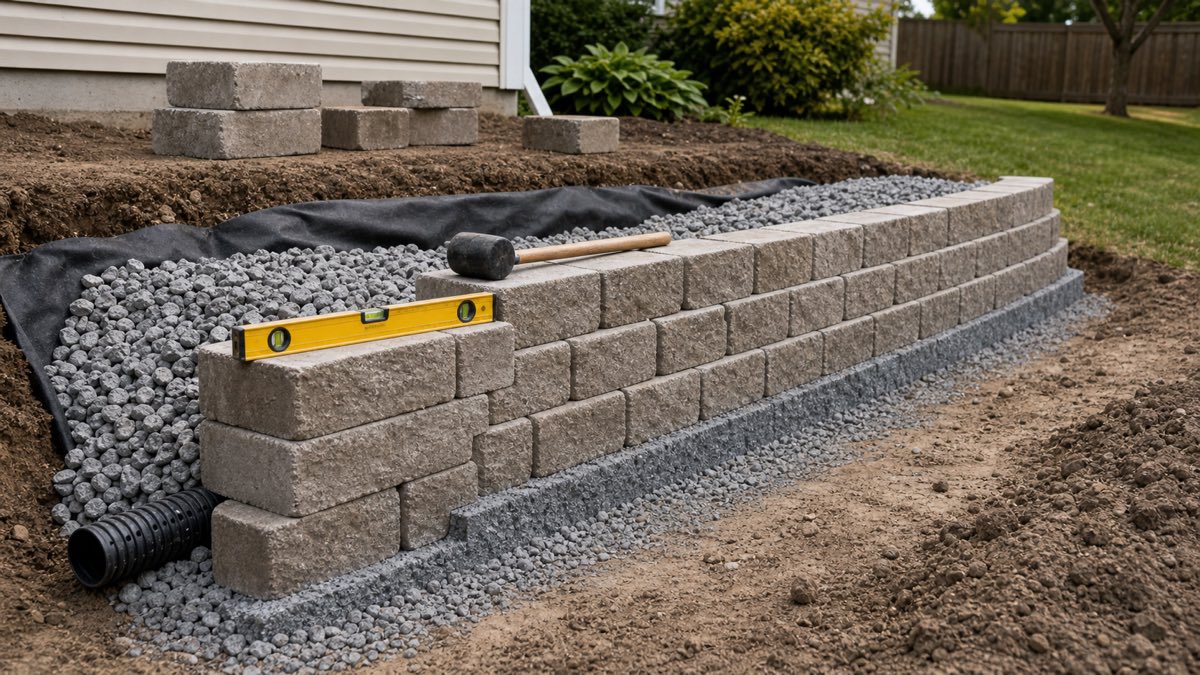
A buried course anchors the wall against the lateral push of the soil it retains. Without it, freeze–thaw cycles and surcharge from rain-saturated backfill can tip the wall outward within 2–5 seasons. The TZ-default rule is one course per ~10% of visible height, minimum one course — so a 24″ wall gets one buried 4″ course, a 48″ wall gets two. Decorative borders that retain almost nothing (4″–6″ visible) can skip it; everything that retains real soil should not.
Why pipe + clean stone + filter fabric — can I skip any of them?
All three solve the same problem (water pressure against the back of the wall) in different ways. Clean stone (no fines, washed #57 or 3/4″) gives water somewhere to go; the 4″ perforated pipe at the base carries it away to daylight; the filter fabric stops surrounding silt from clogging the stone. Skip the fabric and your gravel turns to mud within 2 years. Skip the pipe and gravel saturates. Skip the gravel and your fabric tears under the wall pressure. They are a system.
When do I really need geogrid?
The industry threshold is 36″ visible height (3 ft) for residential walls with normal surcharge (no driveway, no slope above). Beyond that, every other course should have a geogrid mat (UX-class biaxial polymer mesh) extending back into the retained soil at least 60% of wall height. Cheap walls skip this; their warranty period is the next winter.
When does a wall need an engineer or permit?
Most US jurisdictions require structural engineering review and a building permit at 4 ft (48″) visible height measured from the bottom of the base course to the top of the wall, per IRC 2021 R404. Slopes above the wall, surcharge from vehicles, or terraced walls within a setback distance of each other can trigger engineering at much lower heights. Check your local building department before you order block.
Describe the task to the AI assistant and continue from the result.
Open AI assistant →How retaining wall block math works
Two numbers decide most of the order: visible courses (block rows above grade) and blocks per course (blocks spanning the length):
- Visible courses:
ceil(visible_height_in / block_height_in). A 24″ wall with a 12×4″ block (a typical small-face residential unit) =ceil(24/4) = 6. - Buried course:
max(1, ceil(0.10 × visible_height_in / block_height_in))when retaining real soil. 24″ wall → one 4″ buried course; 48″ wall → two. - Blocks per course:
ceil(length_ft × 12 / block_width_in). A 20-ft wall with 12″ blocks = 20. - Base count:
(visible + buried) × blocks_per_course. 24″ × 20 ft →7 × 20 = 140. - Add waste — 5% straight, 10% curved:
ceil(140 × 1.05) = 147wall blocks. Capstones add one row (20 here).
Why the buried course is non-negotiable
A retaining wall stands against the ground, not on it. Soil load doubles with wall height and triples when backfill is saturated. The buried course stops the bottom from sliding outward — skipping it to save 20 blocks is the single most common cause of a 4-year-old leaning wall. ICPI TR127B: bury at least 10% of visible height, minimum one course. Defaults on for retaining walls; off for borders that retain almost nothing.
Worked example — 20 ft × 24″ low retaining wall
- Visible 6 + buried 1 = 7 rows × 20 blocks/course = 140 base + 5% waste = 147 wall blocks + 20 capstones.
- Base trench (24″ × 6″ × 20 ft): 0.74 yd³ of #57 clean stone.
- Drainage gravel behind wall (12″ × 36″ × 20 ft): 2.22 yd³.
- 4″ perforated pipe, slits-down, sloped 1/8″/ft to daylight: 20 lf.
- Filter fabric U-wrapping the stone zone: 61 sqft.
The drainage stack — all three, not just one
Clean stone (#57, no fines) lets water flow. The 4″ perforated pipe at the base carries it away. The filter fabric stops surrounding silt from clogging the stone. Skip the fabric and your gravel turns to clay in 18 months. Skip the pipe and the stone saturates. Skip the stone and the fabric tears under wall pressure. They are one system, not three options.
Reinforcement thresholds — when geogrid, when engineering
| Visible height | What you need |
|---|---|
| Up to 36″ (3 ft) | Plain gravity wall — block weight alone holds it. |
| 36″–48″ (3–4 ft) | Structural biaxial geogrid (UX-class polymer mesh) every other course, embedded ≥60% of wall height into retained soil. |
| Over 48″ (4 ft) | Structural engineering review + building permit (IRC 2021 R404 in most US jurisdictions). |
Common questions
How deep should the base trench be?
Up to 24″ visible: 6″ compacted base, 24″-wide trench. 24–48″ walls: 8″ base. Trench bottom below local frost depth. Compact in two 3″ lifts — the flattest base course is the cheapest insurance against leaning.
Buried course on a 12″ decorative wall?
Against a flat lawn, no — soil load is trivial. Against any slope or frost-susceptible soil, yes. Defaults “on” for retaining walls, “off” for Garden Border preset.
Curves and corners — extra waste?
Curves: bump waste 5% → 10%, plan wet-saw wedge cuts. Inside curves under 4 ft radius often need a smaller block family. Outside 90° corners need a manufacturer-specific corner block — count separately. Both curves and corners: budget 12–15%.
Estimator only. Sizes residential gravity / low-reinforced walls. Walls over 4 ft visible, vehicle-load walls, terraced sets, or walls in expansive soil need an engineer. The gravel calculator handles base + drainage tonnage by depth; the concrete footing calculator sizes any cast-in-place footing on a tall wall.
