Estimate sand for paver bedding, sandbox fill, pool bases, mortar, and polymeric paver joints — yards, tons, and 50 lb bag counts with rectangle, circle, and triangle shapes.
Inches accept fractions: 12 5/8, 12-5/8, or 12.625
Advanced · bag size · coverage · custom density
Sand reference — type, density, where it belongs
| Type | t/yd³ | Use |
|---|---|---|
| Concrete / sharp sand | 1.5 | Paver bedding, pool base, mortar mix |
| Mason sand | 1.4 | Mortar, smooth-finish work |
| Play sand | 1.4 | Sandbox only — washes out under pavers |
| All-purpose sand | 1.4 | General fill, leveling |
| Polymeric sand | by bag | Paver joints — binds when wet |
Densities are loose bulk averages. Compacted-in-place density is ≈10% higher; order an extra 10% if you compact between lifts.
Describe the task to the AI assistant and continue from the result.
Open AI assistant →Two sand modes, two formulas
Sand splits into two estimating problems that don’t share math:
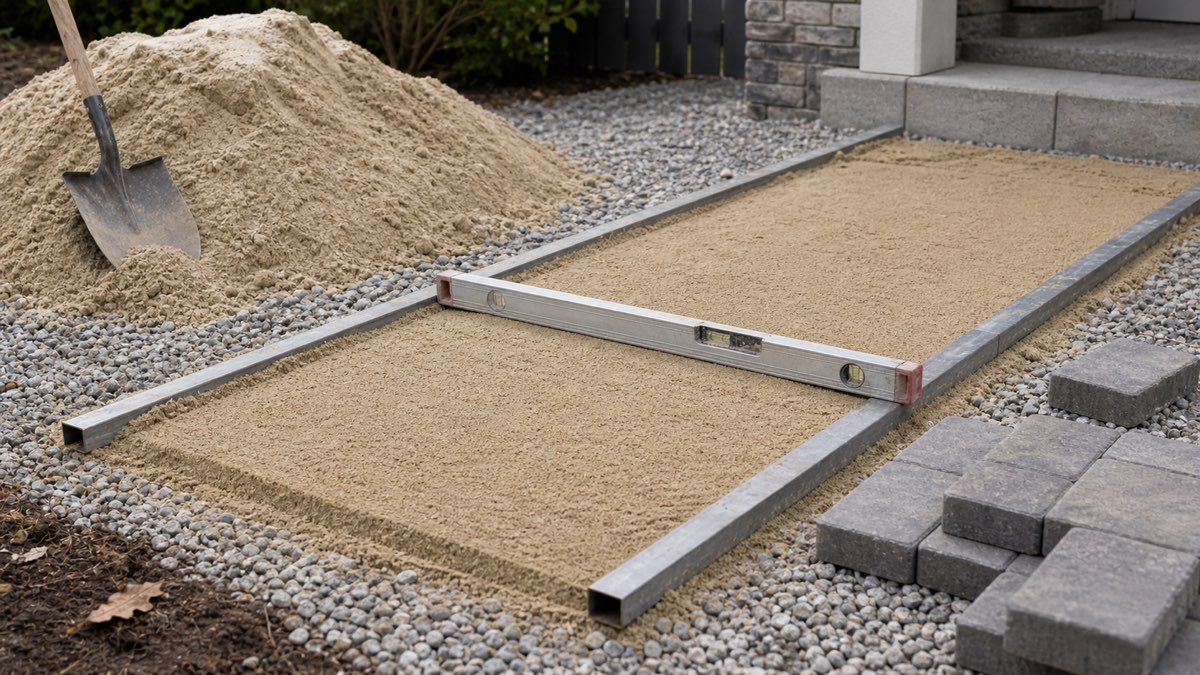
- Volume sand — paver bedding, sandbox fill, above-ground pool base, court surface, mortar mix. Sized by area × depth, ordered by the cubic yard, the ton, or the 50 lb bag.
- Polymeric (joint) sand — the binder you sweep into paver joints. Sized by paver area × joint width, ordered by the bag against a manufacturer coverage table. Cubic yards are meaningless here.
Mixing the two modes is the most common estimating error: a user orders 30 bags of polymeric for a sandbox or 2 yd³ of concrete sand for the joints on a 250 sqft patio. The calculator above keeps the two scopes separate.
Worked example — 18 ft round pool base at 2 in
The most-searched sand scenario, and the one most calculators get wrong by quietly treating the pool footprint as a rectangle:
- Pool footprint is a circle, so
area = π × radius² = π × 9² = 254.47 sq ft(not 18 × 18 = 324). - Depth in feet:
2 / 12 = 0.167 ft. - Volume in cubic feet:
254.47 × 0.167 = 42.41 ft³. - Cubic yards:
42.41 / 27 = 1.57 yd³. - 50 lb bags (0.5 ft³ each):
ceil(42.41 / 0.5) = 85 bags. - Weight at 1.5 t/yd³ (concrete sand, the right material for pool bases):
1.57 × 1.5 = 2.36 short tons.
If you used the rectangle approximation you’d buy 27% too much sand — about 23 extra 50 lb bags and an unhappy bag-in/bag-out drive home.
Sand type reference
| Type | Density (t/yd³) | Where it belongs | Where it doesn’t |
|---|---|---|---|
| Concrete / sharp sand | 1.5 | Paver bedding, pool base, mortar mix, concrete component | Sandbox (too sharp under kids’ feet) |
| Mason sand | 1.4 | Mortar, smooth-finish stucco, tuck-pointing | Paver bedding (too fine, washes out) |
| Play sand | 1.4 | Sandboxes, traction during ice storms | Anything load-bearing or below pavers |
| All-purpose sand | 1.4 | General leveling, low-traffic fill | Structural use, paver joints |
| Polymeric sand | (by bag) | Paver joints only — binds when wet | Volume fill or bedding (it’s a binder, not a base) |
Densities are loose bulk averages from NRMCA and Quikrete spec sheets. Compacted-in-place density is roughly 10% higher; if your job involves lifts and a plate compactor, add 10% to the cubic-yard order.
Polymeric coverage by joint width
| Joint width | Sq ft per bag (≈40 lb) |
|---|---|
| 1/8″ — tight joints, smaller pavers | ~70 |
| 1/4″ — standard (most concrete pavers) | ~50 |
| 3/8″ — wide joints, irregular stone | ~40 |
| 1/2″ — flagstone, large-format slabs | ~30 |
Numbers blend the Alliance Gator, Techniseal, and SRW manufacturer charts — all three converge inside ±5 sqft. Read your specific bag before ordering; tinted or fast-set blends sometimes have lower coverage.
Why play sand stays in the sandbox
Play sand is washed and round-grained — safe for kids’ hands, useless as a paver base. Round grains roll under load and wash out of joints with the first rainstorm; pavers laid on play sand develop rocking corners within a season. The calculator throws a visible warning if you pick play sand for any pour 2 in or shallower in a rectangle or circle — the shape of paver beds and pool bases.
Common questions
How many 50 lb bags equal a cubic yard of sand?
A 50 lb bag holds about 0.5 ft³ of sand, and 1 yd³ = 27 ft³, so 54 bags per cubic yard. Cheap by the bag for jobs under a yard; switch to bulk delivery above 2 yd³ — most landscape suppliers deliver loose sand for 30–50% less per ton than the bagged equivalent.
Polymeric sand or regular joint sand?
Polymeric for any joint that needs to resist weed growth, ant tunneling, or pressure-washer maintenance — driveways, patios, walkways. Regular kiln-dried joint sand for ornamental flagstone where you’d rather replace sand annually than risk a tinted polymeric haze on the stone face. Polymeric must be installed completely dry and activated with a fine mist; if rain hits it mid-application it will haze the paver surface permanently.
Should I order extra for compaction?
For paver bedding (1–1.5 in), the bag count already accounts for the screed lift; no extra. For deeper fills compacted in lifts (court bases, pool bases), add 10% — compacted sand occupies roughly 10% less volume than loose. Polymeric needs none — joint volume is fixed.
Estimator only. Final order should reconcile against your supplier’s slip — bag yields vary 0.45–0.55 ft³ in practice, and bulk-delivered sand settles in transit. For the crushed-stone base layer underneath most paver builds use the gravel calculator; for the slab math when your project starts with a poured base, the concrete calculator.
