Estimate sod by yard area: pallet count, roll count, and slab count with editable pallet coverage and 5 percent waste built in.
| Sale unit | Coverage each | Need (with waste) |
|---|---|---|
| Pallet | 450 sqft | 3 |
| Roll (small) | 10 sqft | 105 |
| Slab | 2.66 sqft | 395 |
Advanced · prices · custom roll & slab size
Why pallet coverage varies — supplier table
| Source | sqft/pallet | Notes |
|---|---|---|
| Small-roll wholesale | ~400 | 40 slabs of 10 sqft, light residential delivery |
| Regional landscape suppliers | ~450 | Most common in the US East and Midwest |
| commercial-pallet suppliers | ~500 | 50 slabs of 10 sqft on a standard pallet |
| Texas farms, some Southwest | ~540 | 60 slabs of 2'×4.5' (9 sqft each) |
| Big-roll commercial sod | ~420 | 2 big rolls of 30"×60' = 300 sqft, or other ratios |
The number on your invoice can shift the pallet count by 10–20% on the same lawn. Always confirm the per-pallet coverage your farm ships before placing an order — the calculator above lets you punch in their number.
Sod weight, delivery, and install timing
Why sod is so heavy
Fresh-cut sod is roughly 60–70% water by weight, plus root mat and a thin layer of topsoil. A standard 450-sqft pallet weighs 2,500–3,500 lb depending on grass type, soil moisture, and harvest season. Bermuda and Zoysia on the heavier end; fescue and ryegrass on the lighter end.
Delivery logistics
One pallet of sod weighs as much as a small car. Your driveway needs to handle the truck (typically a flat-bed with a forklift or a pallet jack), and you need a flat, firm spot to drop pallets. If access is tight, ask the farm about small-roll delivery instead — 50 individual rolls are easier to wheelbarrow into a backyard than a 3,000 lb pallet.
The 24-hour rule
Sod is alive when it arrives. In warm weather (over 80°F), the roots dry out and the leaves yellow within 24 hours on the pallet — install delays past that day mean buying replacement sod. In cool weather (under 65°F), you have closer to 48 hours, but the same logic applies. Schedule delivery for the morning of install, prep the soil the day before, and water the sod within 30 minutes of laying each section.
FAQ
Pallets, rolls, or slabs — which should I order?
Slabs (typically 16"×24", about 2.66 sqft) come stacked on a pallet — the standard for medium-to-large lawns and the cheapest per square foot. Small rolls (2'×5', about 10 sqft) come bundled and roll out on flat ground — easier to handle for tight backyards or one person. Big rolls (30"×60', 150 sqft, or 42"×120', 420 sqft) need a machine to install — used by commercial crews on athletic fields. For most homeowners with a yard under half an acre, slabs on a pallet are the practical choice.
Why is 5% waste the default, and when should I bump to 10%?
5% covers normal cut waste — every slab has to fit a straight edge against the next, and curves around a flower bed mean trimming. If your lawn is mostly straight rectangles, 5% is enough; some installers use even less. Bump to 10% for yards with tree rings, curved beds, narrow strips next to walks, or first-time installation where mistakes are likely. The leftover sod is good lawn-repair material for the first season — keep it shaded and watered if you want to use it within a week.
Can I lay sod over my existing lawn?
No — kill or strip the old turf first. Sod laid on top of grass has nowhere to root and dies within two weeks. Either spray with a non-selective herbicide and wait two weeks, or rent a sod cutter and remove the existing turf to bare soil. Then loosen the top inch, level, and lay fresh sod within 24 hours of delivery.
Describe the task to the AI assistant and continue from the result.
Open AI assistant →Pallet coverage is the number that changes everything
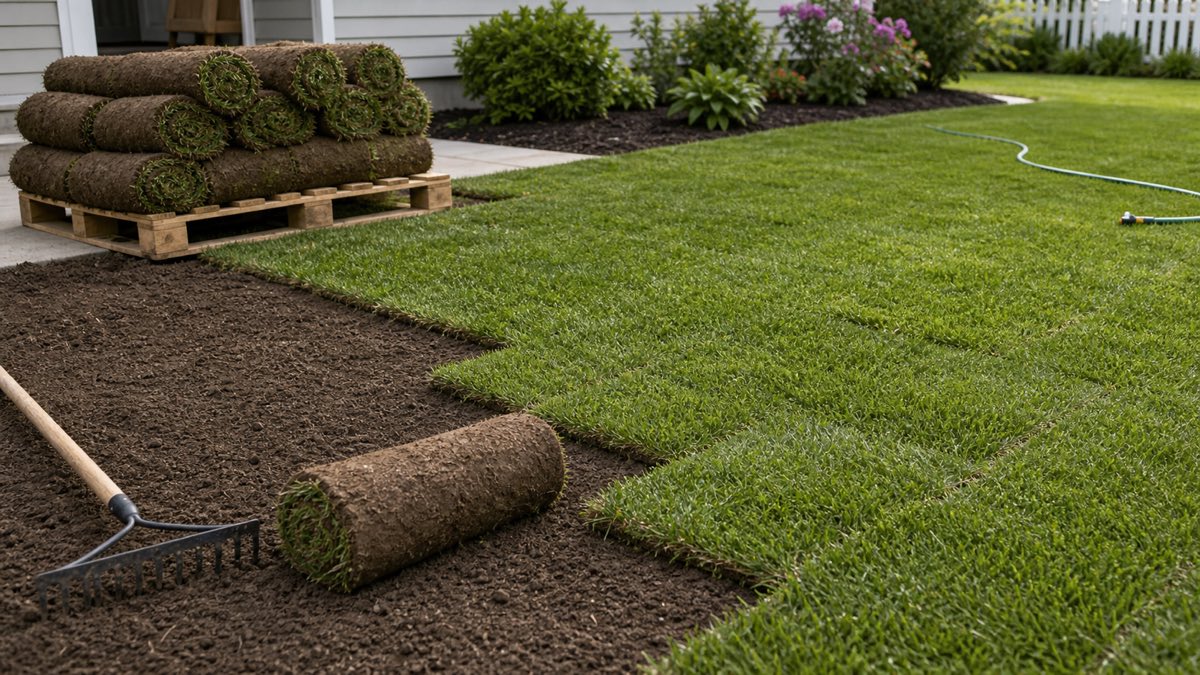
Most sod calculators assume every pallet covers the same area. Real US sod farms ship pallets sized to local cut-strip dimensions, and the per-pallet coverage drives the order more than the lawn size does.
| Supplier style | sqft / pallet | Typical region |
|---|---|---|
| Small-roll wholesale | ~400 | Light residential, urban delivery |
| Regional landscape suppliers | ~450 | East, Midwest — the most common assumption |
| National retail / commercial farms | ~500 | National retail, commercial-grade |
| Texas farms (60 slabs × 9 sqft) | ~540 | Texas, parts of the Southwest |
On a 10,890 sqft quarter acre with 5% waste, this swings the pallet count from 22 to 29 — a $1,000+ difference. Call the farm, ask for sqft per pallet, then enter that number in the calculator above.
Worked example — 30×40 ft backyard
- Base area:
30 × 40 = 1,200 sqft - With 5% waste:
1,200 × 1.05 = 1,260 sqft - Pallets at 450 sqft each:
ceil(1,260 / 450) = 3 pallets - Leftover after rounding:
3 × 450 − 1,260 = 90 sqft of extra coverage - Equivalent in small rolls (10 sqft each):
ceil(1,260 / 10) = 126 rolls - Equivalent in 16″×24″ slabs (2.66 sqft each):
ceil(1,260 / 2.66) = 474 slabs - Estimated weight:
3 × 3,000 lb = 9,000 lb on the truck
If the same farm ships 500 sqft pallets, the answer drops to 3 pallets either way — but on a half-acre lawn the difference compounds: 51 vs 46 vs 43 vs 39 pallets at 400 / 450 / 500 / 540 sqft each.
Why 5% waste — and when to bump to 10%
5% covers the cuts you make at edges, along walks, and where the last strip is narrower than a full slab. For most rectangular yards, 5% is enough; some commercial installers run on 3%. Bump to 10% if:
- The lawn has curved beds or tree rings that force lots of trimming.
- You have narrow strips alongside driveways and walkways where each slab wastes a third of its width.
- You are installing for the first time — beginner mistakes waste 5% on top of the cut allowance.
Leftover sod is good lawn-repair material for the first month. Stack the extra slabs in shade, water once a day, and use them within a week to patch tire ruts and bare spots.
Warm-season vs cool-season — when to lay it
The quantity does not change with grass type, but the install window does.
- Warm-season (Bermuda, Zoysia, St. Augustine, Centipede)
- Lay from April through early September. Soil must be warm — these grasses root at soil temperatures of 65 °F or higher. Avoid mid-summer heat in the Deep South unless you can water twice a day for the first two weeks.
- Cool-season (Kentucky bluegrass, tall fescue, perennial ryegrass)
- Lay in early fall (September–early November) for the best root establishment, or in spring after the last frost. Avoid mid-summer entirely; cool-season sod laid in July rarely roots before drought damage.
The 24-hour install rule
Sod is alive when it arrives. Once it leaves the farm, the roots start drying out, and the leaf blades begin to yellow within hours. In warm weather (over 80 °F / 27 °C), you have roughly 24 hours from harvest to install before the roots die back enough to compromise establishment. In cool weather (under 65 °F / 18 °C), the window extends to about 48 hours. Either way:
- Prep the soil the day before delivery — kill or remove existing turf, loosen the top inch, level, and water.
- Schedule delivery for the morning of install day, not the night before.
- If pallets must sit, stand them in shade and lightly water the tops every few hours.
- Lay the first section within 30 minutes of breaking the pallet seal, water that section before opening the next.
Pallet, roll, or slab — which to order
Slabs on a pallet are the cheapest per square foot and the standard for medium-to-large lawns. Small rolls (2’×5′, ≈10 sqft each) are easier to wheelbarrow into tight backyards and need no machine to install. Big rolls (30″×60′ = 150 sqft, or 42″×120′ = 420 sqft) are commercial — they need an installer head and a tractor, but they go down five times faster on athletic fields and large estates.
Common questions
Why is my pallet count different from another calculator’s?
Almost always the pallet coverage default. Most online tools hard-code 450 sqft per pallet; if your supplier ships 500 sqft pallets, that one assumption is off by 10% before you even start. Enter your supplier’s number in the field above and the count corrects itself.
Can I lay sod over existing lawn?
No — the new sod has nowhere to root. Either spray a non-selective herbicide and wait two weeks for the old turf to die, or rent a sod cutter and strip the existing grass to bare soil. Then loosen the top inch with a rake, level, and lay fresh sod within 24 hours of delivery.
What does a pallet of sod weigh?
A typical 450 sqft pallet weighs 2,500–3,500 lb (1,150–1,600 kg) — fresh-cut sod is roughly two-thirds water by weight. Bermuda and Zoysia run heavier, fescue and ryegrass run lighter. Your driveway needs to handle the truck, and the pallet drop spot needs to be flat and firm — pallets dent gravel and damage soft lawns.
Estimator only. Pallet coverage, slab size, and pallet weight all vary by farm and region; confirm with your supplier before ordering. For other yard projects see the mulch calculator for bed coverage, or the gravel calculator for walks and drives.
