Estimate tiles, boxes, thinset, and grout for floors, backsplashes, and showers — pattern-aware waste, multi-surface builder, and per-surface breakdown in one tool.
Tile
Inches accept fractions: 12 5/8, 12-5/8, or 12.625
Surfaces
| Surface | sqft | tiles | waste % |
|---|
Box mode · custom box coverage
Match your store's box label. Default is 15 sqft per box (typical 12×12).
Optional: prices
Describe the task to the AI assistant and continue from the result.
Open AI assistant →Why pattern changes the waste %
A tile that is laid in a straight grid generates one cut per perimeter row. A tile turned 45° (diagonal) generates two triangular cuts per row, and most of each cut is scrap — neither half slots into the next row. Herringbone and Versailles compound the same problem: every interior tile starts at an angle, so trim pieces from one row cannot feed the next. That is why the sliding-scale waste table below is not arbitrary.
Pattern → waste reference
| Pattern | Default waste | When to use higher |
|---|---|---|
| Stacked grid | 5 % | Add 2–3 % for plumbing penetrations or alcoves. |
| Straight grid | 10 % | Default for square rooms with 0–2 cut perimeters. |
| Running bond / brick offset | 12 % | The half-tile starts force one extra cut per course. |
| Diagonal 45° | 15 % | Triangular perimeter cuts cannot feed the next row. |
| Herringbone | 20 % | Every perimeter tile is a custom cut. Bump to 22 % for very narrow rooms. |
| Versailles / French cut | 20 % | Four-tile module repeats — no perimeter trim recycles. |
Tile size reference
| Tile | Tiles / sqft | Typical use |
|---|---|---|
| 3×6 in subway | 8.0 | Backsplash, shower walls — 12 per box (≈1.5 sqft). |
| 4×12 in subway | 3.0 | Large subway for shower walls — ≈25 per box. |
| 6×24 in plank | 1.0 | Wood-look porcelain — needs 12 % waste minimum for offset. |
| 12×12 in | 1.0 | Default bathroom floor — 15 sqft per box at home centers. |
| 12×24 in | 0.5 | Large-format porcelain — lippage-check every joint. |
| 8 in hex | 2.25 | Mosaic sheets — count boxes by sqft, not by tile. |
Worked example — bathroom floor 5 × 8 ft, 12×12 tile
- Floor area:
5 × 8 = 40 sqft - Tiles per square foot for a 12×12 tile:
144 / (12 × 12) = 1 - Tiles with 10 % waste (straight grid):
ceil(40 × 1 × 1.10) = 44 - Boxes at 15 sqft per box:
ceil(40 × 1.10 / 15) = 3— buy 1 extra for future repair from the same lot. - Thinset for 40 sqft at the 60 sqft / 50 lb bag midpoint:
ceil(40 / 60) = 1 bag. - Sanded grout for a 1/8″ joint, 12×12 tile coverage ≈13 sqft per lb:
40 / 13 ≈ 3.1 lb. A 10 lb bag covers the job with leftover for future patches.
Grout coverage — sanded vs unsanded
Use unsanded grout for joints under 1/8″ (1/16″ subway, mosaic, polished marble that the sand would scratch). Use sanded grout for 1/8″ and wider — the sand keeps it from cracking as it cures across the gap. The estimator above flips the recommendation automatically when you set the joint width.
Coverage drops sharply with both joint width and tile size. A 12×24 tile at 1/8″ joints uses about 16 sqft per pound; a 3×6 subway at 1/16″ uses 14 sqft per pound — the smaller tile has nearly four times the linear feet of joint per square foot of wall. A pound stretches further on the big tile because there is less joint to fill.
Common questions
Why does pattern change waste % so much?
It is a cut-recycling problem, not a tile-quality issue. In a straight grid, the trim from one perimeter row often slots into the next row. In herringbone, every perimeter tile sits at 45° to the wall — the trim is a triangle that cannot feed any other position. With 20 % overhead built in, you cover the perimeter without a return trip to the store mid-job.
What size mortar trowel for which tile?
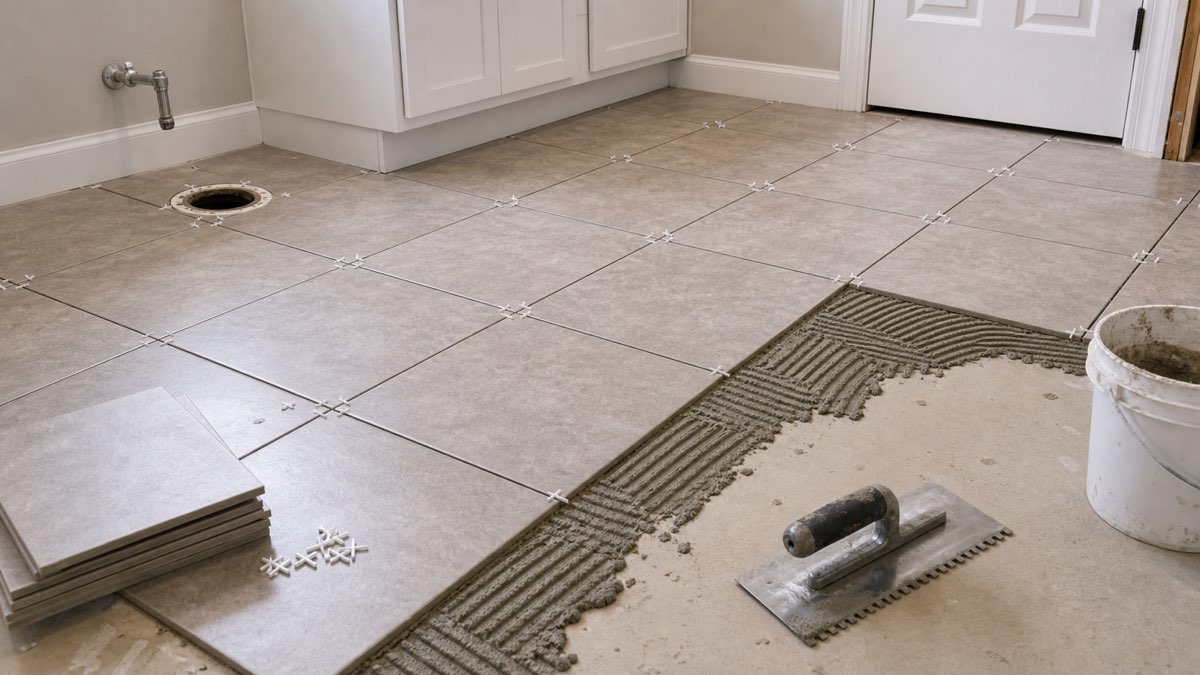
For 3×6 subway and small mosaics, a 1/4″ × 1/4″ U-notch leaves the right ridge. For 12×12 floor tile, step up to 1/4″ × 3/8″ square-notch. Large-format 12×24 and 6×24 plank need 1/2″ × 1/2″ to guarantee 80 %+ mortar coverage — anything less and the tile rocks, cracks, or sounds hollow when tapped. The 50 lb bag count above assumes the matching trowel size for each tile bracket.
Sanded vs unsanded grout — what really happens if I pick wrong?
Unsanded grout in a wide (1/8″+) joint will shrink as it cures and crack within months. Sanded grout in a narrow (under 1/8″) joint won’t pack into the gap properly and will crumble at the surface. Sanded grout on polished marble or glass mosaic will scratch the surface — use unsanded or epoxy. Pick by joint width first, then by tile material if it is a delicate finish.
Related calculators
- Tile adhesive calculator — drill into thinset coverage by trowel and tile size.
- Tile grout calculator — by-tile grout volume with the full Polyblend matrix.
- Concrete calculator — for the slab under the tile job.
Estimator only. Tile-lot color drift between production runs is the most common cause of late-job material shortages — buy 1 extra box from the same lot at the start, even if the math says you do not need it. Replacement boxes from a different lot will look subtly different, and the difference is most visible exactly where you patched.
