Estimate concrete block count, mortar bags, grout-fill cubic yards, and rebar for CMU walls with Quick Start presets for garage, garden, foundation, and retaining walls.
12 5/8, 12-5/8, or 12.625.Openings (doors, windows) · subtract from area
Add door, window, or garage openings to deduct from wall area.
| Material | Quantity | Unit |
|---|---|---|
| Concrete blocks | 227 | blocks |
| Type S mortar (80-lb premix) | 9 | bags |
Reverse: I have N blocks · how much wall area?
Enter how many blocks you have on hand and the block size — see how much wall you can build.
Optional cost · prices per unit
How the math works
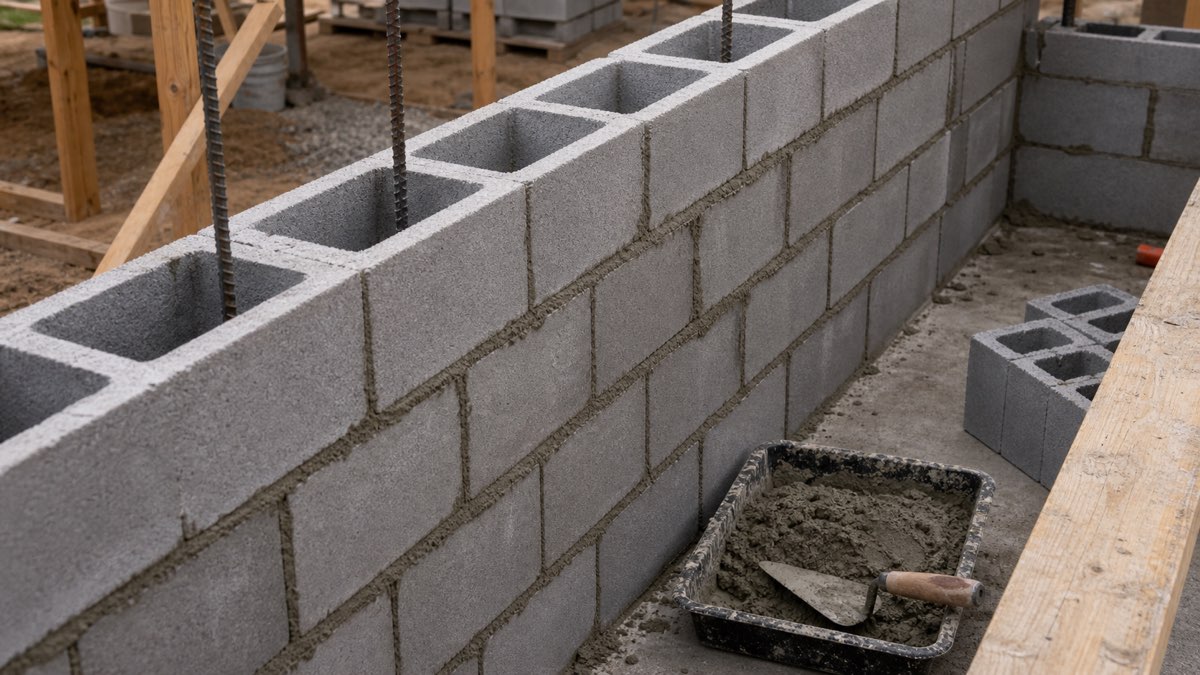
CMU walls scale by face area, not volume — every standard 8″-tall block (8×8×16, 6×8×16, 10×8×16, 12×8×16) covers the same 119 in² of wall face once you account for the 3/8″ mortar joint. Width changes the structural rating, not the count.
- Net area:
length × height − openings - Block count:
area × blocks_per_sqft(1.125 for any 8″-tall unit, 2.25 for 4×4×16 half-height) - Round up with waste:
ceil(blocks × (1 + waste%)) - Mortar (80-lb Type S premix):
ceil(blocks × multiplier / 13.5)— wider blocks need more mortar (12″ uses ≈20% more than 8″) - Grout fill:
blocks × core_volume × fill_fraction
For the slab the wall sits on, the concrete calculator handles bag counts and ready-mix yards; for the footing under a load-bearing wall, see the concrete footing calculator.
Worked example — 24×8 ft garage wall, 8″ block
- Net area:
24 × 8 = 192 sqft - Base blocks:
192 × 1.125 = 216 - Order with 5% waste:
ceil(216 × 1.05) = 227 blocks - Layout:
12 courses × 18 blocks per course - Mortar:
ceil(227 × 1.0 / 13.5) = 17 × 80-lb bags - Reinforced cells at 32″ o.c. grouted:
227 × 0.0556 × 0.25 = 3.16 cu ft≈ 6 bags grout
Swap to a 12×8×16 basement-wall block: count stays 227, mortar bumps to 21 bags (×1.20), grout per block doubles from 0.0556 to 0.112 cu ft.
CMU size reference
| Nominal | Actual W (in) | Blocks/sqft | Core void (ft³/block) | Use |
|---|---|---|---|---|
| 4×8×16 | 3⅝ | 1.125 | 0.014 | Veneer, partition |
| 6×8×16 | 5⅝ | 1.125 | 0.029 | Non-load partition |
| 8×8×16 | 7⅝ | 1.125 | 0.0556 | Standard structural |
| 10×8×16 | 9⅝ | 1.125 | 0.085 | Heavy structural |
| 12×8×16 | 11⅝ | 1.125 | 0.112 | Basement, retaining |
| 4×4×16 | 3⅝ | 2.25 | 0.028 | Half-height capping |
Source: NCMA TEK 14-13B and ASTM C90 hollow load-bearing CMU dimensions. Two-cell standard hollow units; A-shape or three-cell variants differ ±10%.
Mortar and grout yield
- 80-lb Type S mortar
- ≈ 1 bag per 13.5 standard 8×8×16 blocks (face-shell bedding). Full bedding doubles consumption.
- 80-lb core fill grout
- 0.60 cu ft yield. At 0.0556 cu ft per 8″ core fully grouted, ≈11 blocks per bag.
- Ready-mix grout
- 1 cu yd ≈ 480 fully grouted 8″ blocks, ≈1,930 at 32″ o.c. Bag-mix becomes impractical above 0.5 cu yd.
Common questions
What waste percentage should I add for CMU?
5% is the residential default — matches what most masonry suppliers print on their take-off sheets. Bump to 10% for irregular openings, curved walls, or stack-bond patterns where you’ll cut more units. Concrete blocks are units, not fluid yardage — over-ordering means a few extras on the pallet, not wasted ready-mix.
Full-bed mortar vs face-shell bedding — which is the 13.5-blocks-per-bag rule?
Face-shell only. That’s the standard for non-load-bearing and lightly loaded CMU per ACI 530 §3.3. Full-bed mortaring (every web, every face) doubles consumption to ≈7 blocks per bag and is required for the bottom course on the footing, around bond beams, and for solid units. If structural drawings call for full bedding, double the mortar bag count.
When do I need to grout-fill the cores?
Three triggers: (1) load-bearing walls per ACI 530 / TMS 402 — every cell with vertical rebar plus all cells in the top three courses; (2) reinforced retaining walls — cells with vertical bar at 32–48″ o.c. plus any cell crossing a bond beam; (3) acoustic or fire-rating upgrades specifying solid-grouted construction. Hollow CMU is fine for fence walls under 6 ft and non-bearing partitions. Anything taller, on a slope, or supporting load needs an engineer’s reinforcement schedule — this calculator estimates material only, not the design.
Estimator only. CMU walls that hold back soil, support a roof, or carry seismic loads need ACI 530 / TMS 402 design. For brick veneers and clay masonry the math runs differently — use the brick calculator instead.
