Estimate paver count by pattern, plus base gravel, bedding sand, polymeric joint sand, edge restraint and landscape fabric — the full patio material kit in one form.
Inches accept fractions: 12 5/8, 12-5/8, or 12.625
| Item | Quantity | Notes |
|---|---|---|
| Pavers (exact with waste) | 336 | 1.0/sqft |
| Base gravel | 3.95 yd³ | ≈ 5.5 tons · @ 4″ |
| Bedding sand | 0.99 yd³ | 54 × 50-lb bags · @ 1″ |
| Polymeric joint sand | 10 bags | @ 3/8″ joint, 50-lb bag ≈ 35 sqft |
| Edge restraint | 72 ft | perimeter, plus 5% spikes |
| Landscape fabric | 352 sqft | area + 10% overlap |
Advanced · base/bedding depth · joint width · waste override · fabric toggle
Reverse: I have N pavers — how many sqft?
Enter how many pavers you have and the paver size — see the area you can cover at your pattern waste.
Reference · pattern waste · base depth · polymeric coverage
Waste % by pattern (industry default):
| Pattern | Waste % | Notes |
|---|---|---|
| Running bond / stacked | 5% | fewest cuts, all straight runs |
| Herringbone 90° | 10% | moderate edge cuts |
| Diagonal | 15% | angled cuts on every border |
| Herringbone 45° | 15% | preferred for driveways — interlock strength |
| Random / fan | 15–20% | circles + fans need the most off-cut waste |
Base depth by use:
| Use | Compacted base | Bedding sand |
|---|---|---|
| Patio / walkway | 4″ | 1″ |
| Driveway, light vehicle | 6″ | 1″ |
| Driveway, heavy / commercial | 8–12″ | 1″ |
Polymeric sand coverage (50-lb bag):
| Joint width | Coverage (sqft/bag) |
|---|---|
| 1/8″ | 90–120 |
| 3/16″ | 60–80 |
| 1/4″ | 40–60 |
| 3/8″ | 30–40 |
| 1/2″ | 20–30 |
FAQ — pack rounding · herringbone waste · polymeric vs regular sand
Why does pack rounding sometimes add more than I expect?
If your exact count lands just above a pack boundary — say 337 pavers when packs are 8 — you have to round up to 344, an 8-paver overhead. Above ~50 packs this is usually <1%; on small jobs it can be 5–8%. Ask the supplier whether they sell broken packs; some stones (Belgard, Pavestone) allow piece counts on patio sizes, others (clay brick pavers) only sell pallets.
Is herringbone really worth the extra 10–15% waste?
For driveways, yes — herringbone 45° interlocks under tire load and resists creep at edges, which is why ICPI recommends it for vehicular surfaces. For patios at foot traffic only, running bond at 5% waste is simpler and 10% cheaper on the paver count alone.
Do I need polymeric sand or will regular masonry sand do?
Polymeric sand contains a polymer binder that hardens with water, locks joints against ant tunneling and weed seeds, and resists wash-out from rain or pressure-washing. Regular masonry sand washes out within 1–2 seasons and is only acceptable on stone-set patios with deeper joints. Polymeric is required on every driveway and the default choice for patios in the US — budget ~$25–35 per 50-lb bag.
Describe the task to the AI assistant and continue from the result.
Open AI assistant →Pattern choice drives both the look and the bill
The paver count above shifts by 10–15% depending only on how you set the stones. ICPI’s published waste figures match what installers see on real jobs: running bond and stacked patterns generate ~5% off-cuts because every long edge is a straight line. Herringbone 90° lifts that to ~10% because the courses break against the perimeter. Herringbone 45° and diagonal lay out at ~15% — every border cut is an angled cut. Random/fan patterns can hit 18–20% because circular runs need scribed pieces. Use running bond for a foot-traffic patio at 5% if you want the cheapest material order; use herringbone 45° on a driveway even though it costs more, because the interlock is what stops paver creep under tire load.
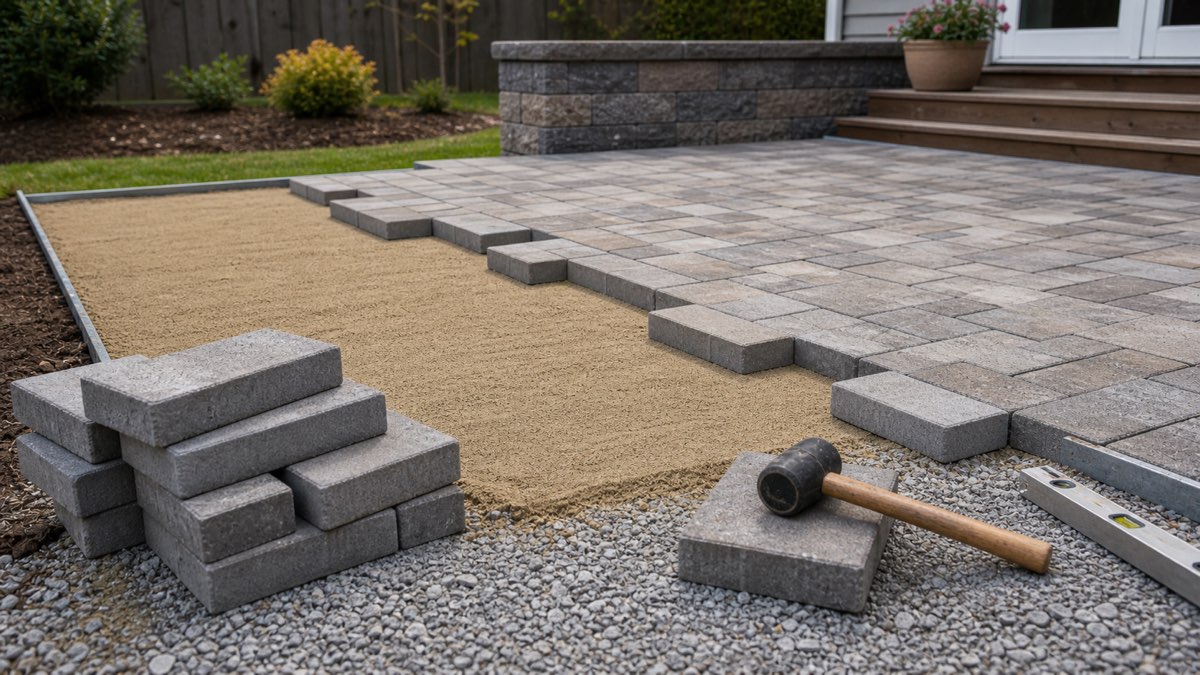
Base, bedding, and joint sand — the three buckets that get forgotten
The paver count is roughly half the order on a real job. The other half:
- Compacted base gravel — 4″ for patios and walkways, 6″ for residential driveways, 8–12″ for heavy or commercial. Use #57 stone or a road-base mix; it gets compacted in 2″ lifts.
- Bedding sand — 1″ of coarse concrete sand laid level over the base, screeded to grade. Not playground sand, not masonry sand for setting bricks — it has to be sharp/angular so it locks. A 50-lb bag yields about 0.5 ft³, so a 16×20 ft patio needs ~54 bags for the bedding course alone.
- Polymeric joint sand — fills the gaps between pavers, hardens with water, and resists ant tunneling, weed seeds, and pressure-washer wash-out. Coverage depends entirely on joint width: a 50-lb bag covers ~100 sqft at 1/8″, ~50 sqft at 1/4″, ~35 sqft at 3/8″. Regular masonry sand washes out in 1–2 seasons; polymeric is required on every driveway and the default for patios in the US.
Worked example — 16×20 ft patio with 12×12 pavers, running bond
- Area = 16 × 20 = 320 sqft
- Pavers per sqft for a 12×12″ paver = 144 / (12 × 12) = 1.0/sqft
- Exact pavers with 5% waste = ceil(320 × 1.0 × 1.05) = 336 pavers
- If pavers ship 8 per pack: ceil(336 / 8) = 42 packs × 8 = 336 (clean fit, no overhead). At 16 per pack: 21 packs × 16 = 336 again — both common patio sizes pack cleanly here.
- Base gravel at 4″ depth = 320 × (4/12) / 27 = 3.95 yd³ ≈ 5.5 tons (using 1.4 t/yd³ road base density)
- Bedding sand at 1″ depth = 320 × (1/12) / 27 = 0.99 yd³ ≈ 26.7 ft³ ÷ 0.5 ft³/bag = 54 × 50-lb bags
- Polymeric sand at 3/8″ joint = ceil(320 / 35) = 10 bags
- Edge restraint = perimeter = 2 × (16 + 20) = 72 linear ft
- Landscape fabric = 320 + 10% lap = 352 sqft
That is the full material kit for one weekend’s worth of patio. The same exercise for the driveway preset (16×40 ft, 6×9 paver, herringbone 45°) jumps to 1,963 pavers, 7.9 yd³ base at 4″ or 11.8 yd³ at 6″ — which is why driveway pavers get ordered in pallets, not packs.
Reference — paver count per square foot
| Paver size (in) | Pavers / sqft | Best use |
|---|---|---|
| 4×8 | 4.50 | walkway, herringbone driveway |
| 6×6 | 4.00 | circles, accent borders |
| 6×9 | 2.67 | Holland / I-shape driveway |
| 12×12 | 1.00 | patio slab — fastest install |
| 12×24 | 0.50 | plank slab, modern look |
| 16×16 | 0.56 | large patio, fewer joints |
| 24×24 | 0.25 | oversized patio slab |
Three common questions
How do packs change the cost?
Suppliers sell most clay brick pavers by the pallet only — broken pallets aren’t allowed. Concrete pavers from major brands (Pavestone, Belgard, Techo-Bloc) usually sell by the piece on patio sizes and by the pallet on contractor jobs. The pack-rounding line on the result tells you the actual paver count you will pay for. If the overhead is more than 5%, ask your yard whether they sell loose pieces — most do for small jobs.
Do I really need landscape fabric under the base?
Yes for soft soils and high-water tables, optional on dry sandy ground. Geotextile fabric (4–6 oz non-woven) keeps the gravel base from punching into the subgrade, which is the #1 cause of paver settlement after year three. It costs about $0.10–0.20 per sqft and a 320-sqft patio needs ~352 sqft including 10% overlap. Skip it only if you’re laying over compacted gravel that’s already in place.
Why is my polymeric sand bag count smaller than I expected?
Joint width is the only variable: at 1/8″ a bag covers 100 sqft, at 3/8″ it covers ~35. Tight joints on 4×8 brick pavers consume far less polymeric than wide joints on 24×24 slabs. The TZ-spec bag coverage numbers in the result are the manufacturer mid-range; real coverage drifts ±15% depending on paver chamfer depth and how aggressively you broom the sand into the joint.
Need just one of the sub-materials? Drop into the dedicated tools: gravel calculator for the base layer when you already know thickness, sand calculator for bedding/joint volume, or concrete calculator if you’re pouring a curb or slab under the paver field. Estimator only — local frost depth, soil bearing, and edge conditions shift the order; confirm with your installer for driveways and any commercial application.
