Estimate pool volume in US gallons, liters, cubic meters and cubic feet for round, oval, rectangle, kidney, L-shape and sectioned pools, with filter turnover, heater BTU and fill-time references.
Inches accept fractions: 12 5/8, 12-5/8, or 12.625
Advanced options · water cost · custom shape factor
Describe the task to the AI assistant and continue from the result.
Open AI assistant →Why pool shape changes the formula
Volume of water is always length × width × depth — the only thing that changes between pool shapes is what counts as “length × width.” Five short rules cover the canonical shapes:
- Rectangle (and L-shape, square hot tub, lap pool)
gallons = L × W × avg_depth × 7.48052— the 7.48052 is the exact ft³-to-gallon factor. L-shape just sums two rectangles. Square spas and hot tubs are rectangles where L = W.- Round (above-ground, plunge)
gallons = π × r² × avg_depth × 7.48052— measure the diameter, not the radius, then halve it. An 18 ft round above-ground at 4 ft = π × 9² × 4 × 7.48052 = 7,613 gal.- Oval (above-ground, lap)
gallons = L × W × avg_depth × 5.9— the 5.9 is the industry shortcut for the ellipse-area fraction (π/4) already multiplied by the ft³-to-gallon factor. A true ellipse is π/4 × L × W × depth × 7.48052 ≈ L × W × depth × 5.87; the industry rounds to 5.9.- Kidney / freeform
gallons = L × W × avg_depth × 7.48052 × 0.85— the 0.85 is a rectangular-bounding-box adjustment. It is an industry estimator with ±5 % real-world variance depending on how aggressively the curves cut into the rectangle. If your pool builder gave you a tag with a “true” volume, prefer that.- Hopper / sectioned
- Sum each zone’s L × W × depth, then convert. Most inground pools with a deep end are really three zones: shallow flat, transition slope, deep flat. The “shallow + deep average” shortcut underestimates by 5–10 % on pools with long transition slopes — section it instead.
Average depth on a varying-floor pool
For most inground pools, the shallow end and the deep end are flat, with a transition slope between them. The standard estimator is avg_depth = (shallow + deep) / 2, and it is exact when the slope occupies exactly half the floor area. When the shallow flat is large and the slope is short — a typical residential 16 × 32 with a 14 ft shallow flat and a 4 ft deep flat — the simple average is within 3–5 % of the true volume. Sectioned mode in the calculator above takes the next step: you enter three zones with their own L × W × D and the result becomes a sum, not an average.
Worked example — 16 × 32 ft inground at 5 ft average
- Surface area:
16 × 32 = 512 ft² - Average depth (3 ft shallow + 7 ft deep) / 2 =
5 ft - Cubic feet:
512 × 5 = 2,560 ft³ - US gallons:
2,560 × 7.48052 = 19,149 gal - Liters:
19,149 × 3.78541 = 72,488 L - Cubic meters:
2,560 × 0.0283168 = 72.49 m³
The same pool sized at 20 × 40 jumps to 29,920 gal / 113,225 L — almost 60 % more water for a pool footprint that is only 56 % larger. Depth is where the gallons multiply.
Reference — pump and filter turnover
A residential pool should turn over its full volume every 8 hours; a heavily used or hot-climate pool should hit 6-hour turnover. Divide gallons by minutes:
| Pool volume | 8-hour GPM | 6-hour GPM |
|---|---|---|
| 10,000 gal (small above-ground) | 21 GPM | 28 GPM |
| 15,000 gal (24′ round) | 31 GPM | 42 GPM |
| 20,000 gal (16×32 inground) | 42 GPM | 56 GPM |
| 30,000 gal (20×40 inground) | 63 GPM | 83 GPM |
| 40,000 gal (large inground) | 83 GPM | 111 GPM |
Pick a pump rated at the head pressure of your plumbing, not the open-flow brochure number. A 1 HP single-speed pump delivers about 50 GPM through typical residential plumbing at 30 ft of head.
Heater BTU and fill time — quick rules
Heater rule of thumb: BTU/hr per 1 °F per hour = gallons × 8.33. A 20,000-gallon pool needs ~166,000 BTU/hr to raise water 1 °F per hour theoretically, with a fitted solar cover. Without a cover, plan for double the BTU to overcome evaporation and convective loss. Most residential gas heaters run 200,000–400,000 BTU/hr.
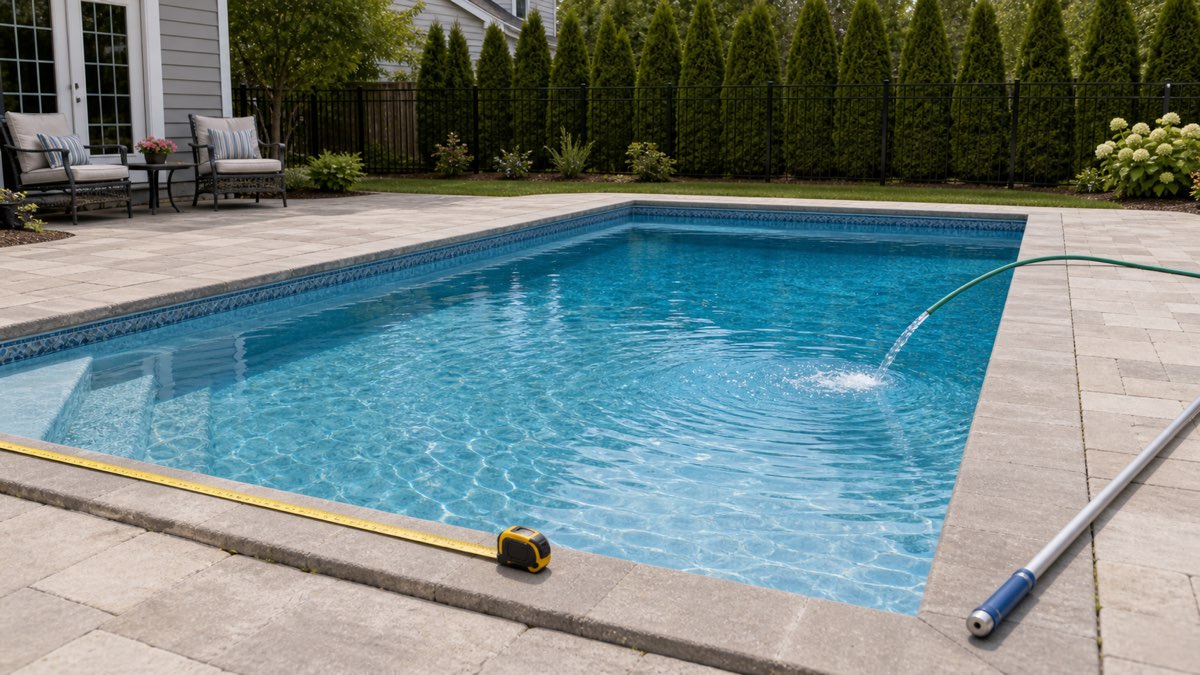
Fill time: at a typical 9 GPM garden hose, 20,000 gallons take ~37 hours. A 5/8″ hose at city pressure delivers 6–12 GPM depending on length and supply — time a 5-gallon bucket from your spigot if you want a real number. Trucked-in water (5,000-gal tanker) finishes a 20,000-gallon fill in four loads.
Why the chemical dosing card carries a disclaimer
The chlorine, pH and alkalinity numbers in the result block above are mid-range references — they assume liquid 12.5 % sodium hypochlorite for chlorine, soda ash (Na₂CO₃) for pH-up, and sodium bicarbonate (NaHCO₃) for alkalinity. Real products vary: powdered cal-hypo is 65–75 % active, dichlor is 56 %, trichlor pucks dose by slow dissolution. Always follow your specific product’s label. Pool stores can read your water sample and dose to current readings, which the calculator does not know.
Three common questions
Why does my pool service quote a different number?
Two reasons. First, they may have measured rather than calculated — vinyl-liner pools shrink slightly versus their nameplate dimensions, and tile depth eats 1–2 inches. Second, they may apply a different shape factor (some use 0.80 for kidney, some 0.85, some build a CAD area). If the difference is under 5 %, it does not matter for chemistry. If it is over 10 %, ask which dimensions they used.
How accurate is the kidney 0.85 factor?
The 0.85 multiplier assumes the kidney shape cuts about 15 % of the area off a rectangular bounding box. Designer kidneys can cut 20–25 % (factor 0.75–0.80); shallower curves leave more area (factor 0.88–0.92). Adjust the kidney factor in Advanced options if you want a tighter estimate or if your builder gave you a different rule.
Do I have to use sectioned mode for a deep-end pool?
Not for chemistry — the (shallow + deep) / 2 shortcut is within 5 % for most residential pools and the chlorine dose tolerance is wider than that. For fill-time and water-cost estimates, the same shortcut is fine. Switch to sectioned mode only if you want a precise gallons figure (e.g., to compare with a builder’s nameplate) and you have actual measurements of all three zones.
Pool deck or surrounding hardscape next? The concrete calculator sizes the cubic yards for a poured concrete deck, the paver calculator handles unit pavers around the coping, and the gravel calculator sizes the compacted base pad for an above-ground pool. Estimator only. Pool builders and service technicians measure on-site and adjust to current readings — use this for ballpark planning, not engineering acceptance or chemical safety.
