Estimate concrete bags per post hole — round or square hole, optional 4×4 or 6×6 post displacement, 5 bag sizes, frost-depth notes.
Inches accept fractions: 12 5/8, 12-5/8, or 12.625
| Bag | Yield ft³ | Bags total | Total weight |
|---|---|---|---|
| 40 lb | 0.30 | 4 | 160 lb |
| 50 lb fast-set | 0.375 | 3 | 150 lb |
| 60 lb | 0.45 | 3 | 180 lb |
| 80 lb | 0.60 | 2 | 160 lb |
| 90 lb | 0.675 | 2 | 180 lb |
Bag yields · focus size · prices override
Edit yields if your label disagrees. Quikrete fast-set 50 lb is treated as a regular bag for volume math — water dose differs, dry-pour is a separate decision per the label.
Frost-line guidance · regional cheat sheet
Hole depth must reach below your region's frost line — concrete-collared posts heave otherwise.
- 12–18″ — Gulf Coast, Florida, Southern California, Arizona, Texas south of San Antonio.
- 24–30″ — Mid-South: Tennessee, Carolinas, North Texas, Oklahoma, Georgia.
- 36–42″ — Mid-Atlantic, Ohio Valley, Pacific Northwest interior.
- 48″ — Northern tier: New York, Michigan, Wisconsin, Iowa, Colorado mountains.
- 60–72″ — Northern Maine, North Dakota, Minnesota, mountain interior.
- 72″+ — Alaska interior, far-north Canada.
Local building department always has the authoritative number — frost depth varies by soil type and groundwater.
Why the post in the hole matters
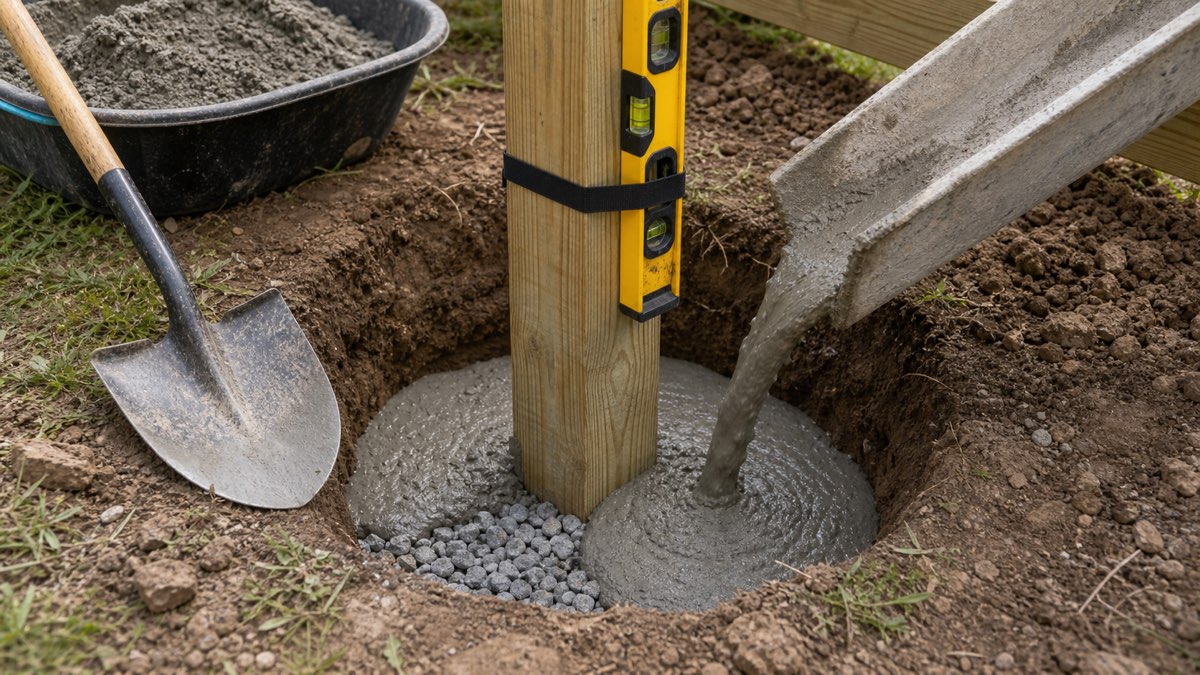
A 10″-diameter, 24″-deep round hole has 1.091 cu ft of empty volume — but if a 4×4 wooden post (3.5″ actual) sits in it, the post fills 0.170 cu ft, leaving only 0.921 cu ft for concrete. Most online tables ignore that and quietly over-order by 15–25%. On a 40-post fence that’s 40 unused bags going home. The calculator always shows both numbers — hole-only and with the post subtracted — so the buy decision is explicit.
Worked example — 12″ × 42″ gate post with a 6×6
A heavy gate hinge post wants a 6×6 (5.5″ × 5.5″ actual) in a 12″-diameter hole, 42″ deep to clear most northern frost lines:
- Hole volume: π × 6² × 42 / 1728 = 2.749 cu ft
- Post displacement: 5.5 × 5.5 × 42 / 1728 = 0.735 cu ft
- Net concrete: 2.749 − 0.735 = 2.014 cu ft
- 60 lb bags (0.45 cu ft): ceil(2.014 / 0.45) = 5 bags
- 80 lb bags (0.60 cu ft): ceil(2.014 / 0.60) = 4 bags
Without subtraction the same hole reads 7×60 lb or 5×80 lb — two extra bags per post. On a four-post gate that’s 8 bags of concrete that never gets mixed. For wider rectangular pours the concrete calculator handles slabs; the concrete bag calculator covers mixed shapes with bag-size comparison.
Frost-line depth — set the hole deep enough
A collar that ends above the frost line heaves in winter: soil water freezes, lifts the concrete with the post in it, drops it back off-center on thaw. After three winters a fence is leaning. Typical depths to clear frost:
| Region | Frost depth |
|---|---|
| Gulf Coast, Florida, Southern California | 12–18″ |
| Mid-South, Carolinas, Georgia, Oklahoma | 24–30″ |
| Mid-Atlantic, Ohio Valley, PNW interior | 36–42″ |
| New York, Michigan, Wisconsin, Iowa | 48″ |
| Northern Maine, North Dakota, Minnesota | 60–72″ |
Local building departments have the authoritative number. The calculator flags any hole shallower than 36″.
Gravel base — 4″ to 6″ of crushed stone
Pour concrete directly on clay and the post bottom sits in standing water every spring — rot follows. A 4–6″ pad of tamped ¾″ crushed stone drains water, lets air around the post end, and gives the collar stable rock to bear on. The gravel calculator sizes the stone order.
FAQ
Round hole or square hole?
Round is the auger default — ~90% of fence and deck installs. Square appears for hand-digging hard ground or pouring a small column footing. Math differs: square uses side × side × depth, round uses π × r² × depth. A 10″ square hole holds about 27% more concrete than a 10″ round.
What about a belled / sloped-bottom collar?
Checking “belled” flares the bottom half to 1.5× the top width, making the plug cone-shaped and impossible to lift as ground freezes. For frost-resistant gate or deck-pier installs in northern climates, belled is the right call. Adds about 30% to the concrete order.
Dry-set or wet-set?
Quikrete Fast-Setting and Sakrete Set-It-Quick allow dry-set (shovel powder, drench, done) for non-structural posts — mailbox, decorative fence. For load-bearing (gate hinges, fence corners, deck piers), wet-mix in a wheelbarrow first; dry-set gives uneven hydration. Rebar isn’t needed for compression-only fence posts but two pieces of #4 dropped vertically before pour are good insurance on gate posts and deck piers — the concrete footing calculator handles load-bearing piers where rebar isn’t optional.
Estimator only. Bag yields are manufacturer label values (Quikrete, Sakrete); real output sits 0–3% lower from subgrade absorption and bag residue. For load-bearing posts this widget sizes the supply trip, not the engineering.
