Calculate risers, riser height, tread count, total run, stringer length, and IRC residential code checks for residential stairs.
| Component | Qty | Length |
|---|---|---|
| Tread boards (1×, 2×) | 13 | 36″ ea. |
| Riser boards (closed risers) | 14 | 36″ ea. |
| Stringer boards (2×12 typical) | 2 | ~16 ft |
Advanced · nosing · floor thickness · headroom
Reference · IRC residential stair limits
| Item | IRC limit | Section |
|---|---|---|
| Maximum riser height | 7.75″ (197 mm) | R311.7.5.1 |
| Minimum tread depth | 10″ (254 mm) | R311.7.5.2 |
| Minimum stair width | 36″ (914 mm) | R311.7.1 |
| Minimum headroom | 80″ — 6′-8″ (2032 mm) | R311.7.2 |
| Nosing overhang | 0.75–1.25″ (19–32 mm) | R311.7.5.3 |
| Handrail required | 4 or more risers | R311.7.8 |
| Variation between risers | ≤ 0.375″ (9.5 mm) | R311.7.5.1 |
| Variation between treads | ≤ 0.375″ (9.5 mm) | R311.7.5.2 |
Commercial stairs follow IBC 1011 (7″ riser max / 11″ tread min, 44″ width). This calculator is residential-only.
How residential stair math works
A code-compliant stair layout starts from one number — total rise, the finished floor-to-floor height — and works outward:
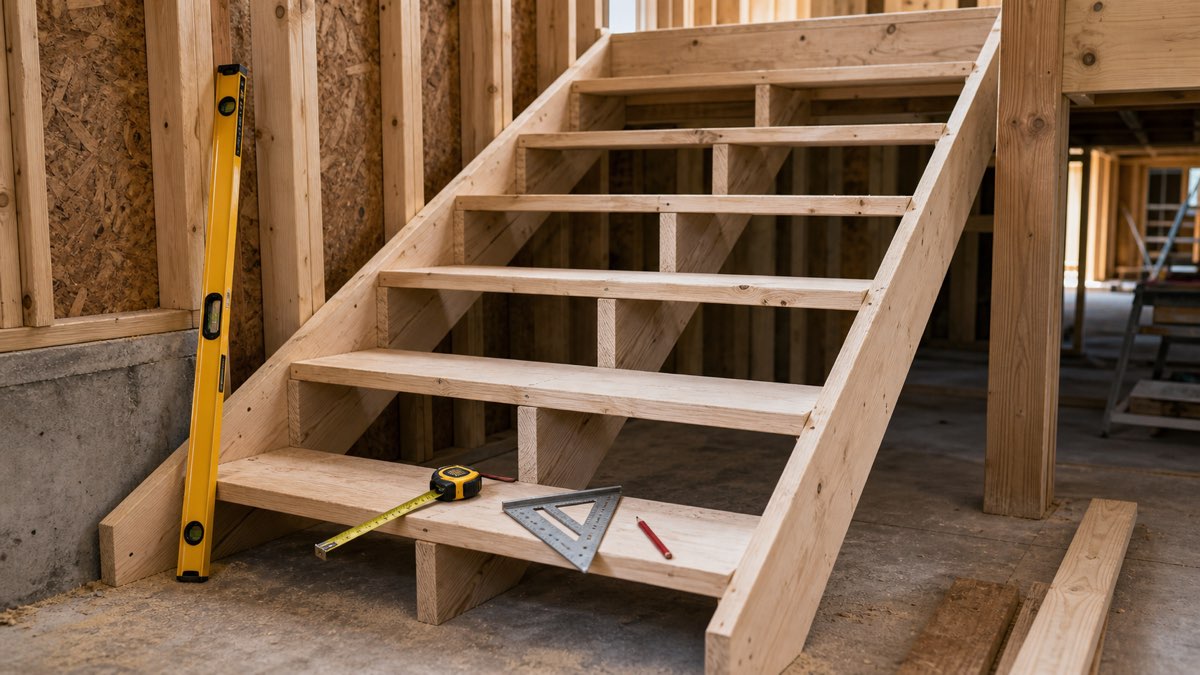
- Find the riser count. IRC R311.7.5.1 caps riser height at 7.75″, so the minimum is
ceil(rise / 7.75). A 108″ floor-to-floor needsceil(108 / 7.75) = 14 risers. - Actual riser height:
108 / 14 = 7.714″. Every riser in a flight must be within 0.375″ of the others — do not mix two heights to “fix” a leftover. - Tread count is one less than risers (the top tread is the upper floor itself):
14 − 1 = 13. - Total run:
tread × tread_count. With an 11″ tread:11 × 13 = 143″. - Stringer length is the hypotenuse:
√(108² + 143²) = 179.2″. Add about 12″ of cut waste before ordering 2×12 stock.
IRC residential limits
- Max riser — 7.75″ (R311.7.5.1)
- Hard ceiling. A single 8″ riser fails inspection in new construction.
- Min tread — 10″ (R311.7.5.2)
- Nosing-to-nosing. The visible board is usually 11–11.5″ to give a 1″ overhang.
- Min width — 36″ (R311.7.1)
- Measured above handrail height.
- Min headroom — 80″ — 6′-8″ (R311.7.2)
- Plumb from any nosing. Basement remodels lose this when a duct crosses the opening.
- Handrail required at 4+ risers (R311.7.8)
- A 3-riser porch can skip it; a 4-riser deck step legally cannot.
- Variation between risers or treads — 0.375″ max
- The “uneven trip step at the bottom” trick is no longer allowed.
Two carpenter rules of thumb
Code minimums let you build code-compliant stairs that still feel awful. Two industry rules predict comfort:
- Blondel’s formula: 2R + T = 24–25″. A 7″ riser with 11″ tread sums to 25 — ideal. A 7.71″ riser with the same 11″ tread sums to 26.4 — legal but cramped.
- R + T = 17–18″. American carpenter’s check. 7 + 11 = 18 ✓.
If your rise forces a high riser (7.5–7.75″), bump the tread to 11.5″ or 12″ to bring 2R+T back into the comfort range.
Worked example — finished basement, 96″ floor-to-floor
- Total rise = 96″ (finished-to-finished). If you measured framing-to-framing, subtract the finished floor in the floor-adjustment field.
- Min risers:
ceil(96 / 7.75) = 13. - Actual riser height:
96 / 13 = 7.385″. - Treads:
13 − 1 = 12. Total run with 11″ treads:11 × 12 = 132″(11 ft). - Stringer length:
√(96² + 132²) = 163.2″. Order 14-foot 2×12 stringers (168″) so cut waste lands in the trim pile. - Angle:
atan(96 / 132) = 36.0°— within the residential-comfortable 30–38° band.
Common questions
My rise doesn’t divide evenly — what do I do?
Almost no real-world rise divides into 7″ exactly. Pick the riser count that gives the lowest actual height under 7.75″. For 108″: 14 risers @ 7.71″ beats 15 @ 7.20″ if floor space is tight; pick 15 if you want a gentler climb. Both pass code. The same math drives the slab pour at the bottom — the concrete calculator sizes the stoop, the stair calc sets the geometry above it.
Is a 2×12 stringer deep enough?
For a standard 7.25″ × 10.5″ layout, a 2×12 (11.25″ actual depth) keeps the throat — the wood behind the cut — above the 3.5″ minimum most span tables require. Deeper risers (7.5–7.75″) eat into the throat and may need a 2×14 or a doubled stringer. The bottom rests on a treated 2× sill plate or a concrete pad, never on soil. The concrete bags calculator sizes a typical 24×24×8″ landing pad at about 3 80-lb bags.
Should I measure framing-to-framing or finished-to-finished?
Always finished-to-finished. Frame first, lay flooring later: measure subfloor-to-subfloor, then enter planned finished thickness (hardwood, tile + thinset, vinyl) in the Advanced floor-adjustment field. A 108″ subfloor with 0.75″ hardwood on top and 0.5″ tile at the bottom is a 106.75″ effective rise — that shift is the #1 reason DIY stairs get rejected at inspection.
When do I need a landing?
IRC permits 12 feet of vertical rise (16 risers) in one flight, but practically: any run over 12 feet (≈ 144″), any direction change, or any doorway at top or bottom needs a landing equal to or greater than the stair width (R311.7.6). For deck stairs landing on grade, pair the geometry from this tool with the deck board calculator when cutting the stair into existing framing.
Estimator for residential stairs only (IRC 2021). Commercial stairs follow IBC 1011 with stricter minimums (7″ riser, 11″ tread, 44″ width). Always verify against local amendments before cutting — many jurisdictions add their own limits, and rural permit offices sometimes adopt older IRC editions. Stringer count is a recommendation, not engineering — verify joist span tables for the load.
